Shared Basis Function Spaces
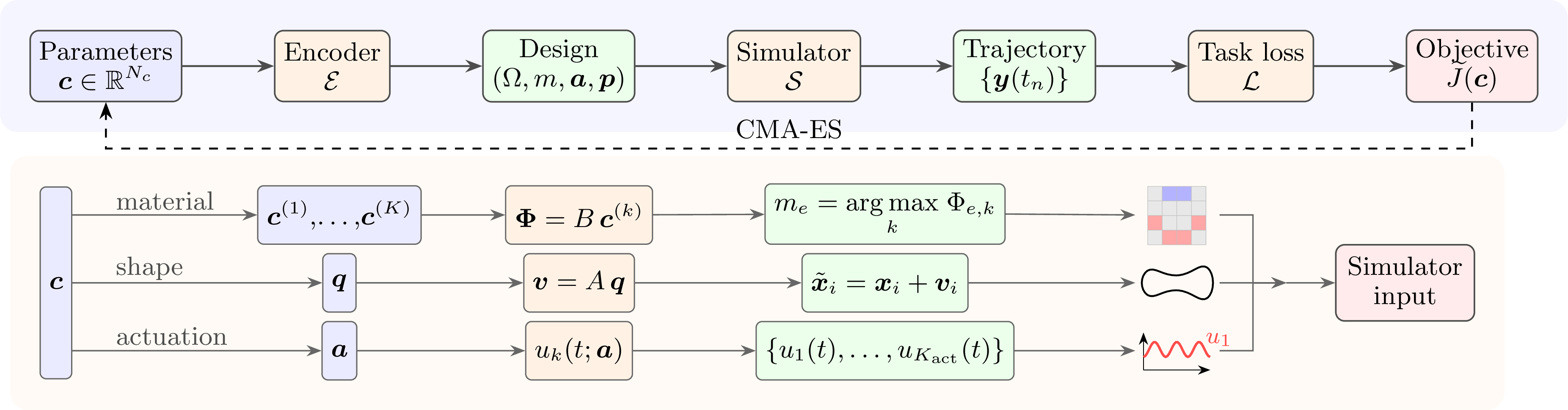
Multi-material score fields and vector-valued deformation fields are both expanded in Gaussian RBF bases, pre-evaluated once as basis matrices B and A on the mesh, so decoding a design reduces to a matrix–vector product.
IEEE/RSJ IROS 2026 (accepted)
* Equal contribution 1 Soft Robotics Lab, D-MAVT, ETH Zurich, Switzerland 2 ETH AI Center, ETH Zurich, Switzerland


Soft robots couple shape, material, and actuation so tightly that optimizing them in isolation fails. We introduce a smooth, low-dimensional basis-function embedding that parameterizes all three jointly, works with any black-box simulator, and scales predictably in expressiveness as more basis functions are added.
Soft robots achieve functionality through tight coupling among geometry, material composition, and actuation, so effective design optimization requires these three aspects to be considered jointly. This coupling is computationally challenging: nonlinear large-deformation mechanics increase simulation cost, while contact, collision handling, and non-smooth state transitions limit standard gradient-based approaches. We introduce a smooth, low-dimensional design embedding for soft robots that unifies shape morphing, multi-material distribution, and actuation within a single structured parameter space. Shape variation is modeled through continuous deformation maps of a reference geometry, and material properties as spatial fields; both constructed from shared basis functions, enabling expressive co-design while drastically reducing the dimensionality of the search space. In our experiments, design expressiveness increases with the number of basis functions, unlike comparable neural network encodings whose representational capacity does not scale predictably with parameter count, and joint co-optimization of shape, material, and actuation consistently outperforms sequential strategies. The proposed embedding, which operates independently of the underlying simulator and is compatible with black-box pipelines, surpasses neural network and voxel-based baselines across multiple dynamic tasks while using significantly fewer design parameters. These findings demonstrate that structuring the design space itself enables efficient co-design of soft robots.
Geometry, material distribution, and actuation are each infinite-dimensional in principle. Direct optimization over such spaces is intractable, and naive element-wise encodings scale poorly with mesh resolution. Our design embedding tackles this by representing all three through a shared set of smooth basis functions, evaluated once on the mesh and reused across the whole pipeline.
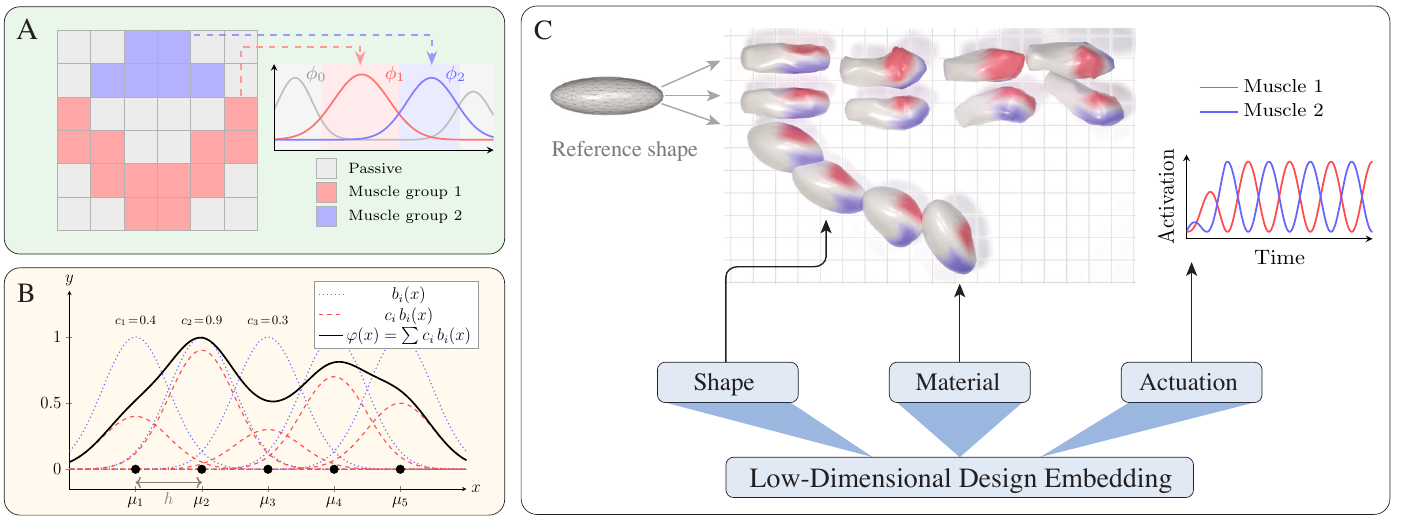
Multi-material score fields and vector-valued deformation fields are both expanded in Gaussian RBF bases, pre-evaluated once as basis matrices B and A on the mesh, so decoding a design reduces to a matrix–vector product.
Smooth deformation maps morph a reference geometry while preserving mesh topology; an implicit occupancy field built from the material scores enables stronger topology change through element-wise thresholding.
The reduced design vector is optimized with CMA-ES, a gradient-free evolution strategy well suited to noisy, non-convex, contact-rich objectives evaluated through an opaque forward simulator.
We first study representational power independently of task dynamics: how does capacity scale with the number of basis functions, both for material distribution and for shape variation?
Material score coefficients are optimized to reproduce a prescribed pattern (a torus and a cross) on a fixed 50×50 grid with two materials, at three basis resolutions. At NΦ=16 the encoder cannot reproduce sharp boundaries; at 36 the topology is recovered; at 64 the match is visually precise — finer basis grids translate directly into higher geometric fidelity.
| NΦ = 16 | NΦ = 36 | NΦ = 64 | Target | |
|---|---|---|---|---|
| Torus | 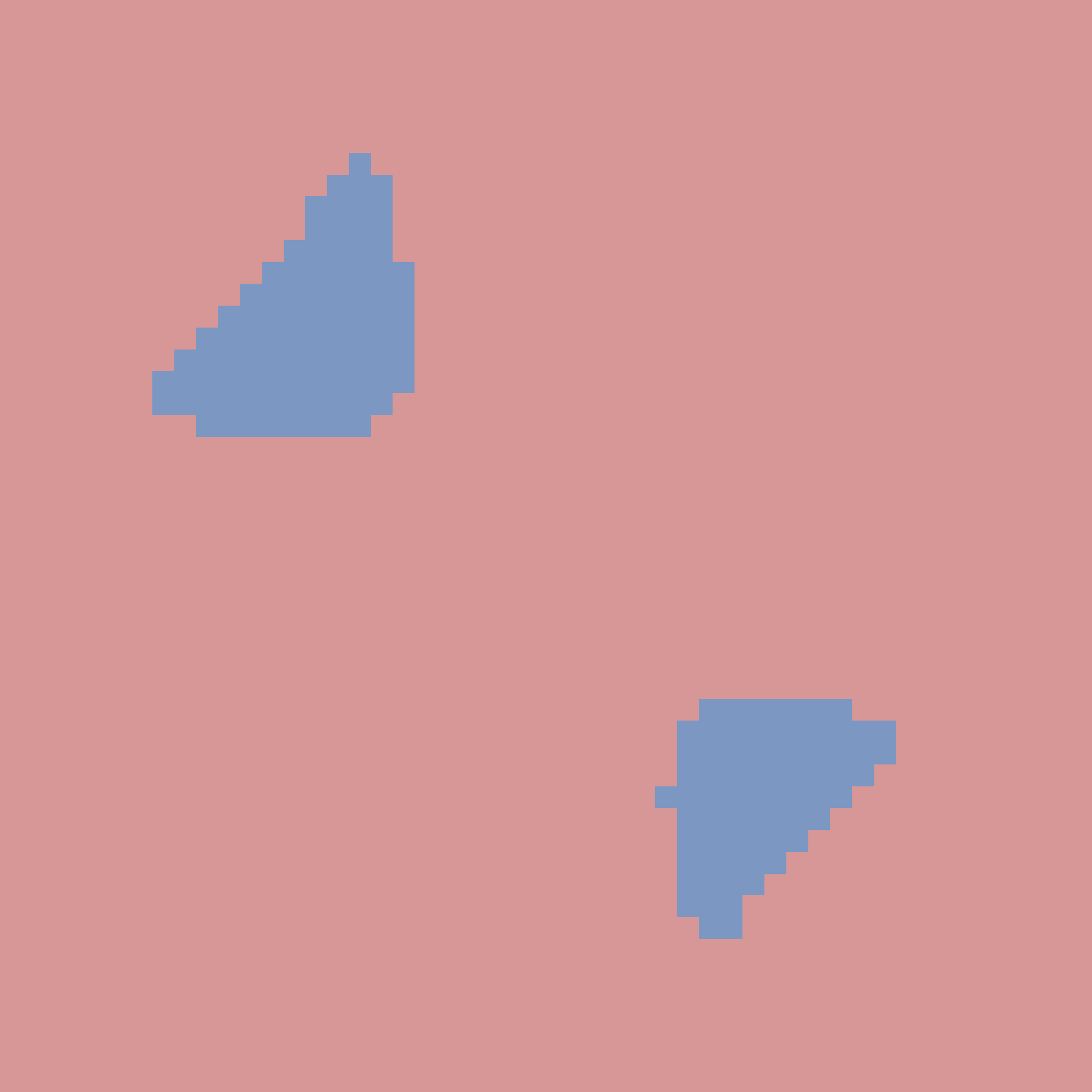 |
 |
 |
 |
| Cross |  |
 |
 |
 |
We sample 2000 random parameter vectors, decode them into shapes by morphing a reference sphere, and measure pairwise Chamfer distances. For the basis function encoder, the intrinsic dimensionality d95 grows from 70 to 395 as the number of basis functions increases; a parameter-matched neural field baseline saturates quickly, rising only from 178 to 228 despite a 20× increase in parameters. A novelty score (nearest-neighbor Chamfer distance) shows the same pattern: steadily increasing for basis functions, nearly flat for neural fields.
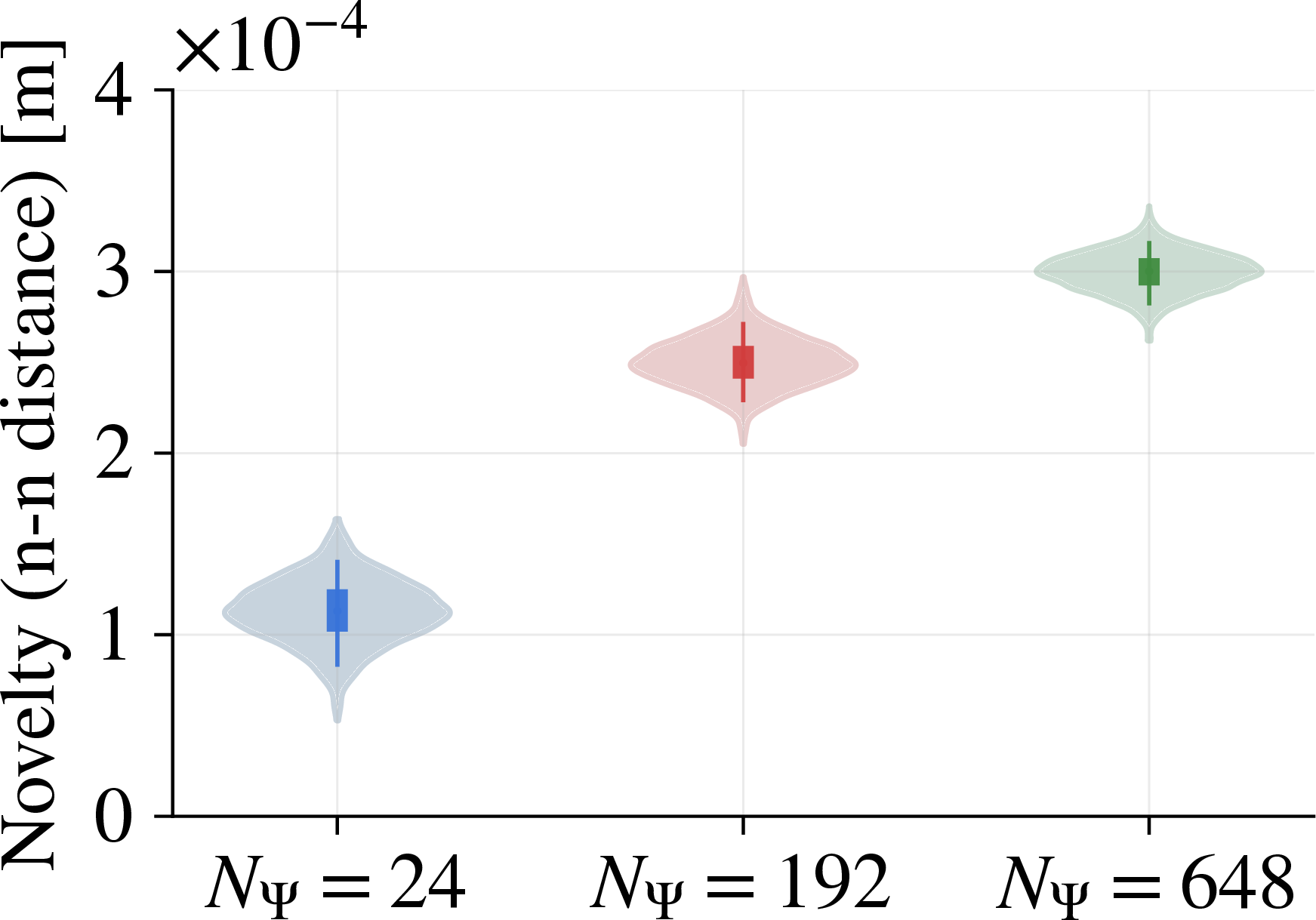
Basis-function encoder
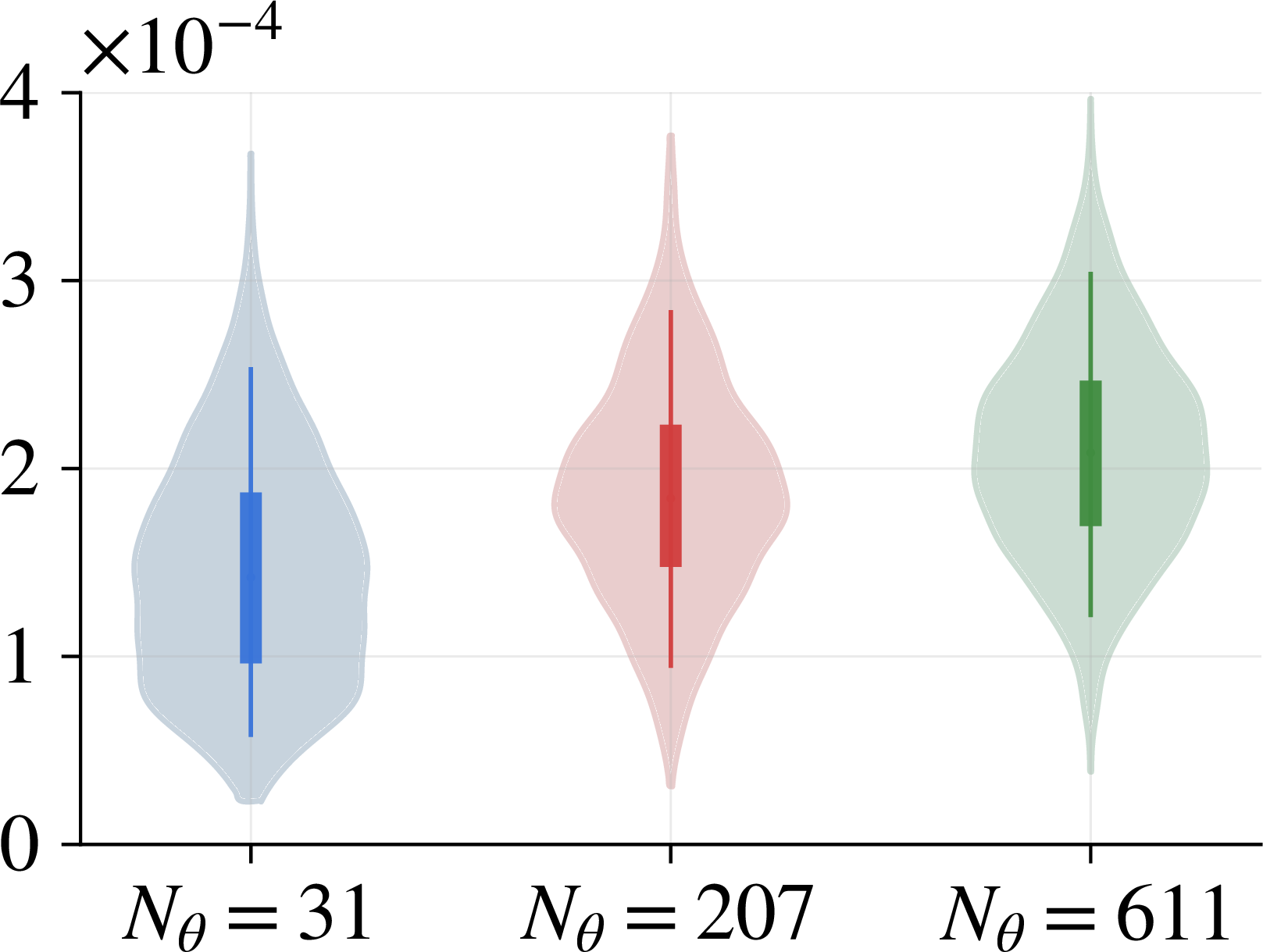
Neural-field encoder
| Encoder | Configuration | Params | d₉₅ |
|---|---|---|---|
| Basis function | 2×2×2×3 | 24 | 70 |
| 4×4×4×3 | 192 | 245 | |
| 6×6×6×3 | 648 | 395 | |
| Neural field | 3→4→3 | 31 | 178 |
| 3→6→12→6→3 | 207 | 216 | |
| 3→8→16→16→8→3 | 611 | 228 |
We test whether jointly optimizing shape, material, and actuation outperforms a sequential strategy (fix morphology, then tune actuation) on two dynamic tasks — swimming and jumping — under the same 10,000-simulation budget.
An ellipsoid reference body with two actuated muscle groups is optimized for forward displacement with lateral-drift, rotation, and muscle-fraction penalties. The co-optimized swimmer reaches a minimal loss of −67.32 versus −61.89 for the sequential strategy, producing a stable, nearly straight trajectory, while the sequential design exhibits axial drift visible in the rotating muscle group.
A cubic reference body with a Gaussian-pulse muscle phase is optimized for jump height and rotation under gravity and ground contact, with topology change through element removal only. The co-optimized jumper reaches a minimal loss of −9.14 versus −7.72 for the sequential strategy, with clearer design asymmetry that enhances rotational movement.
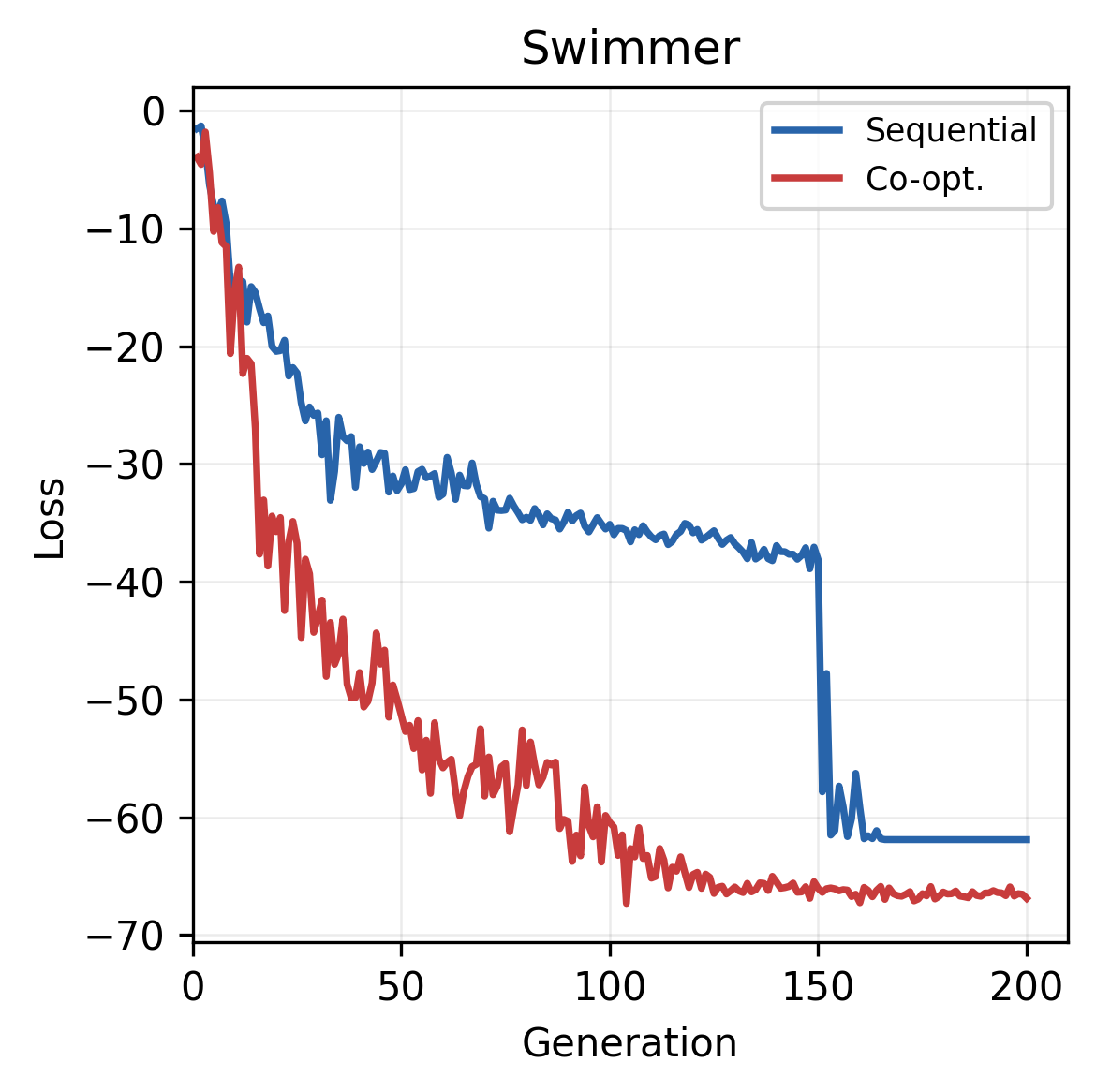
Swimmer
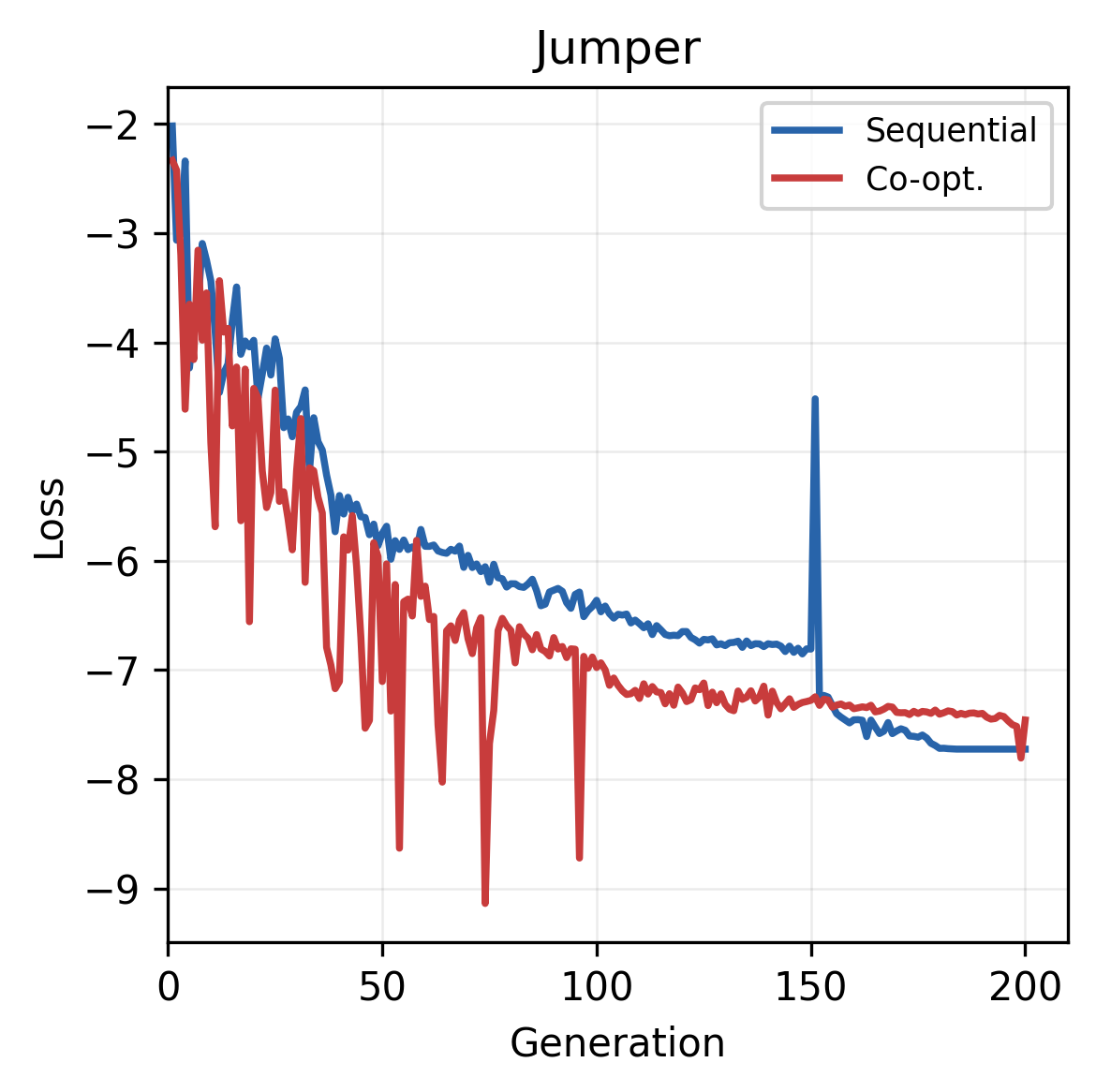
Jumper
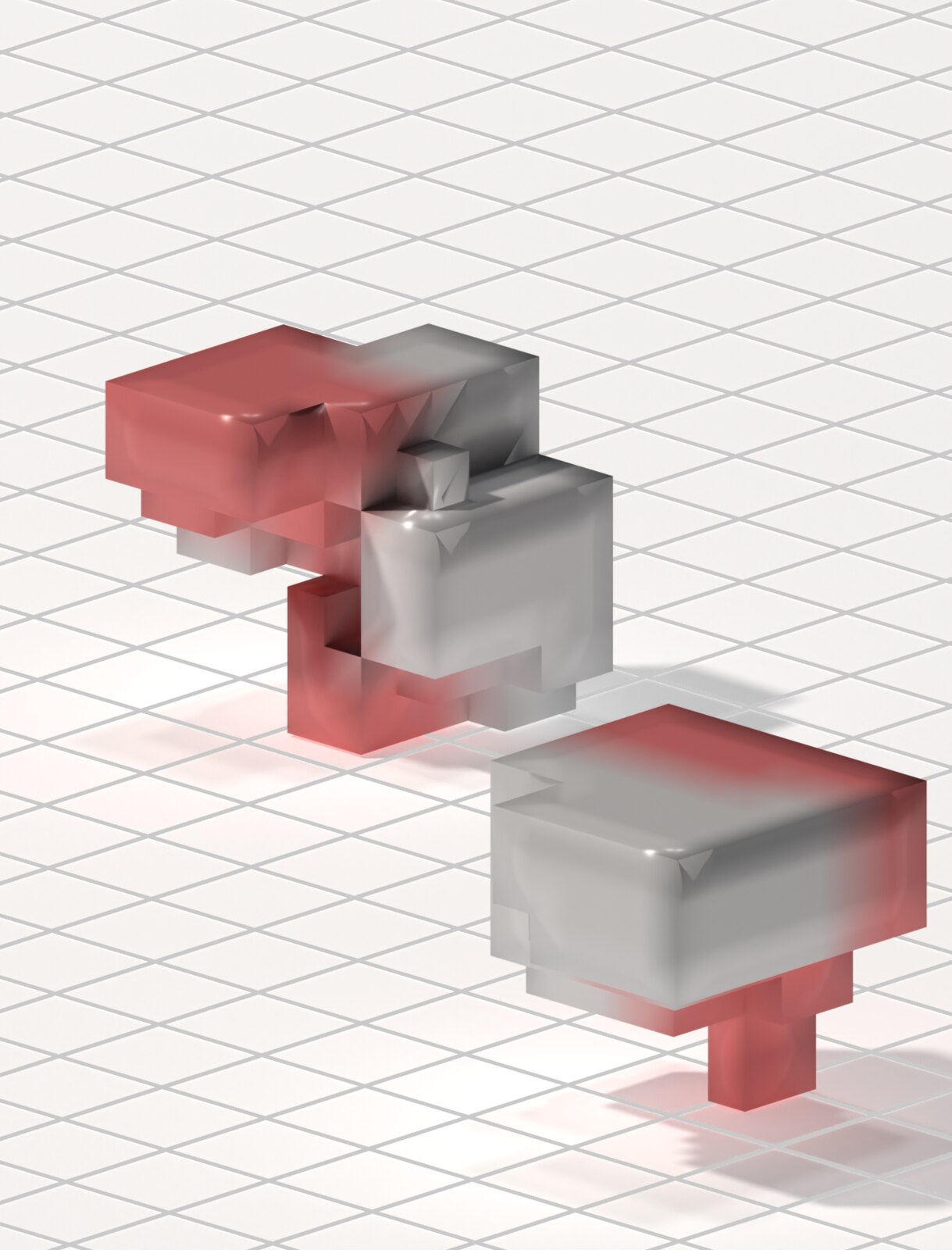
t = 0 ms — initial configuration.
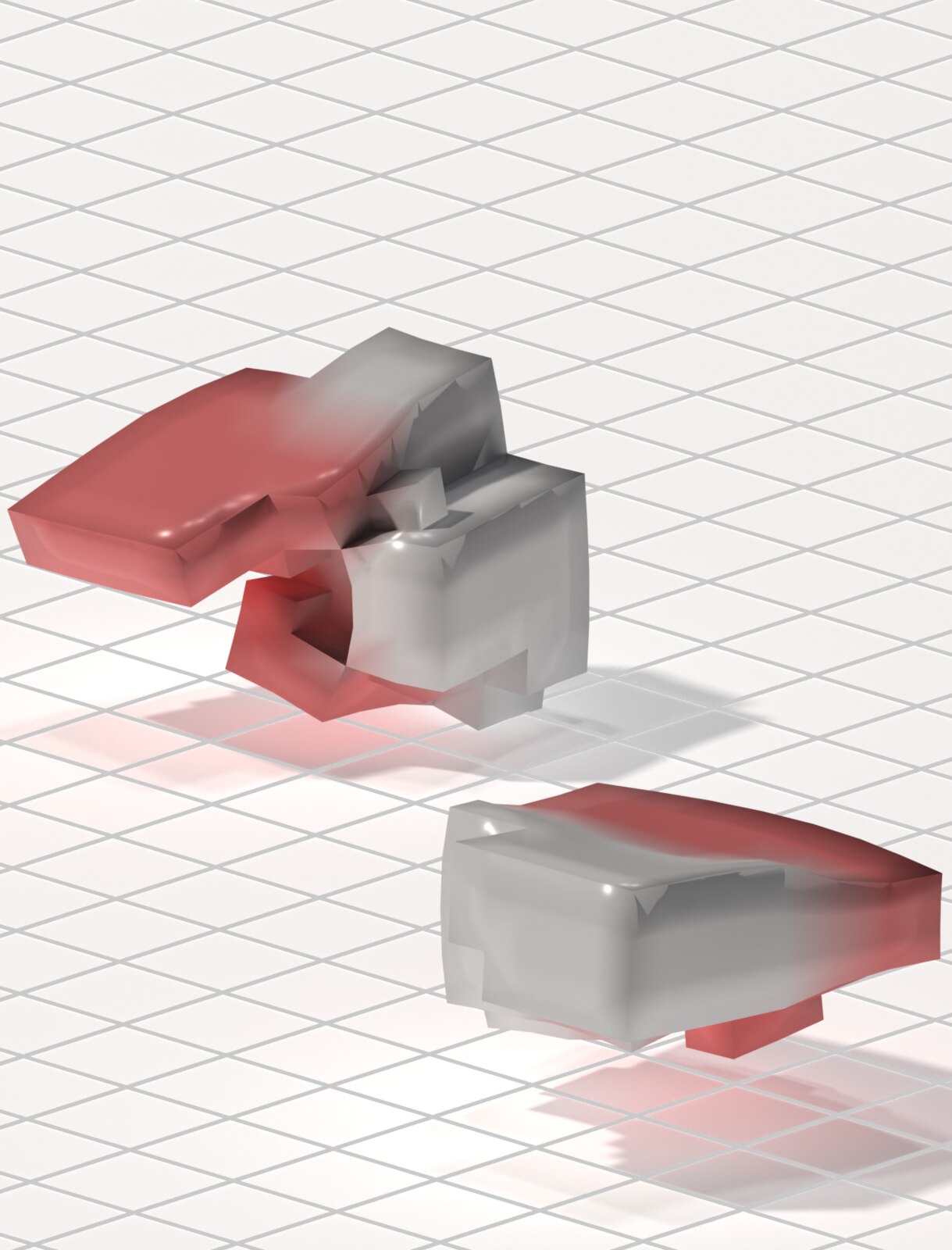
t = 50 ms — ground-contact compression.
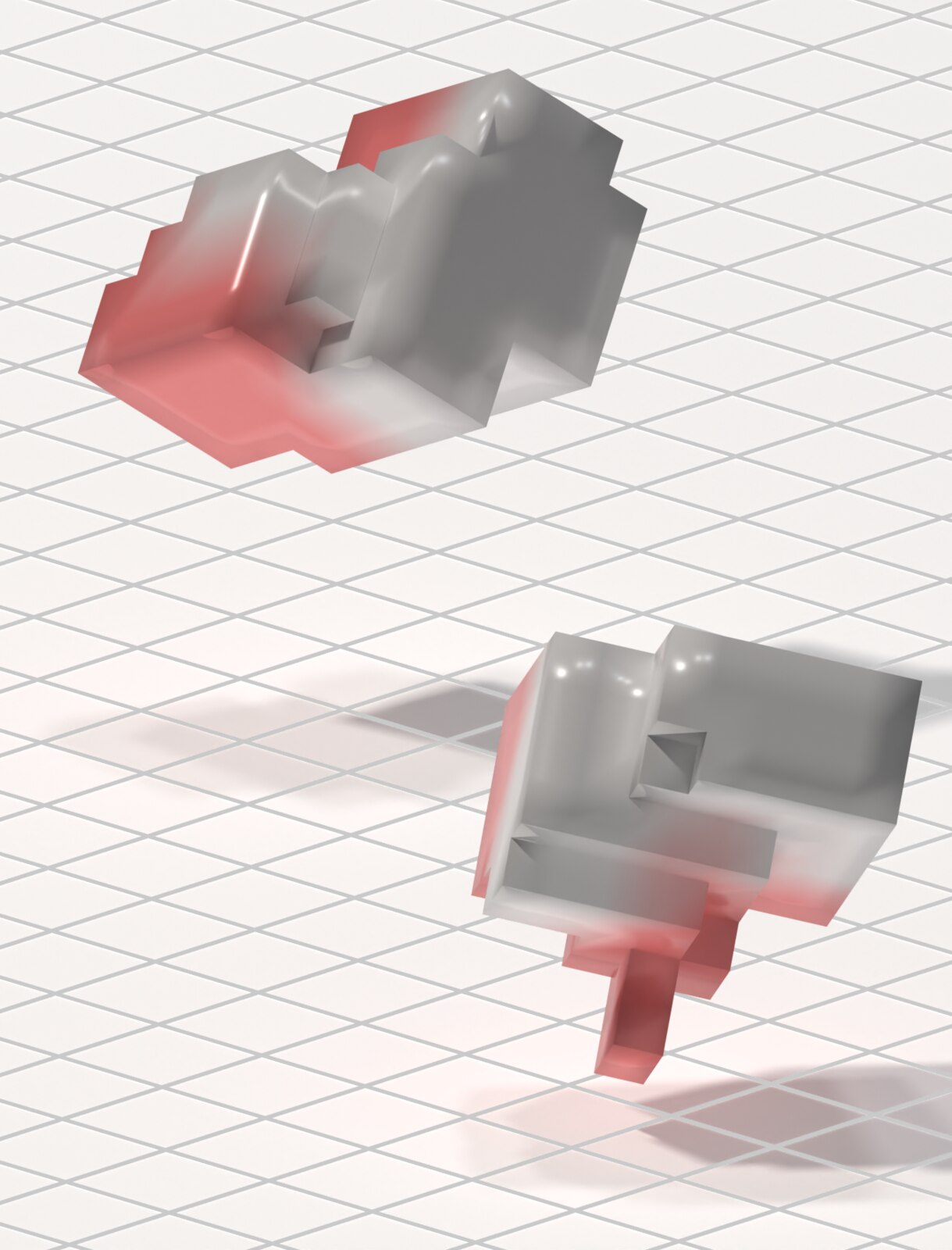
t = 200 ms — mid-flight.
The neural field baseline for swimming (149 parameters, matched to our 147) makes almost no progress during the first half of optimization and converges to a design with visible lateral drift, while the basis function encoder improves within the first few generations — evidence of a more navigable loss landscape from a linear, spatially local parameterization. For jumping, a per-voxel baseline (346 parameters, roughly 6× more than our 57) yields a fragmented, scattered muscle distribution and a worse final loss despite the larger parameter count, while the basis function jumper stays compact and coherent.
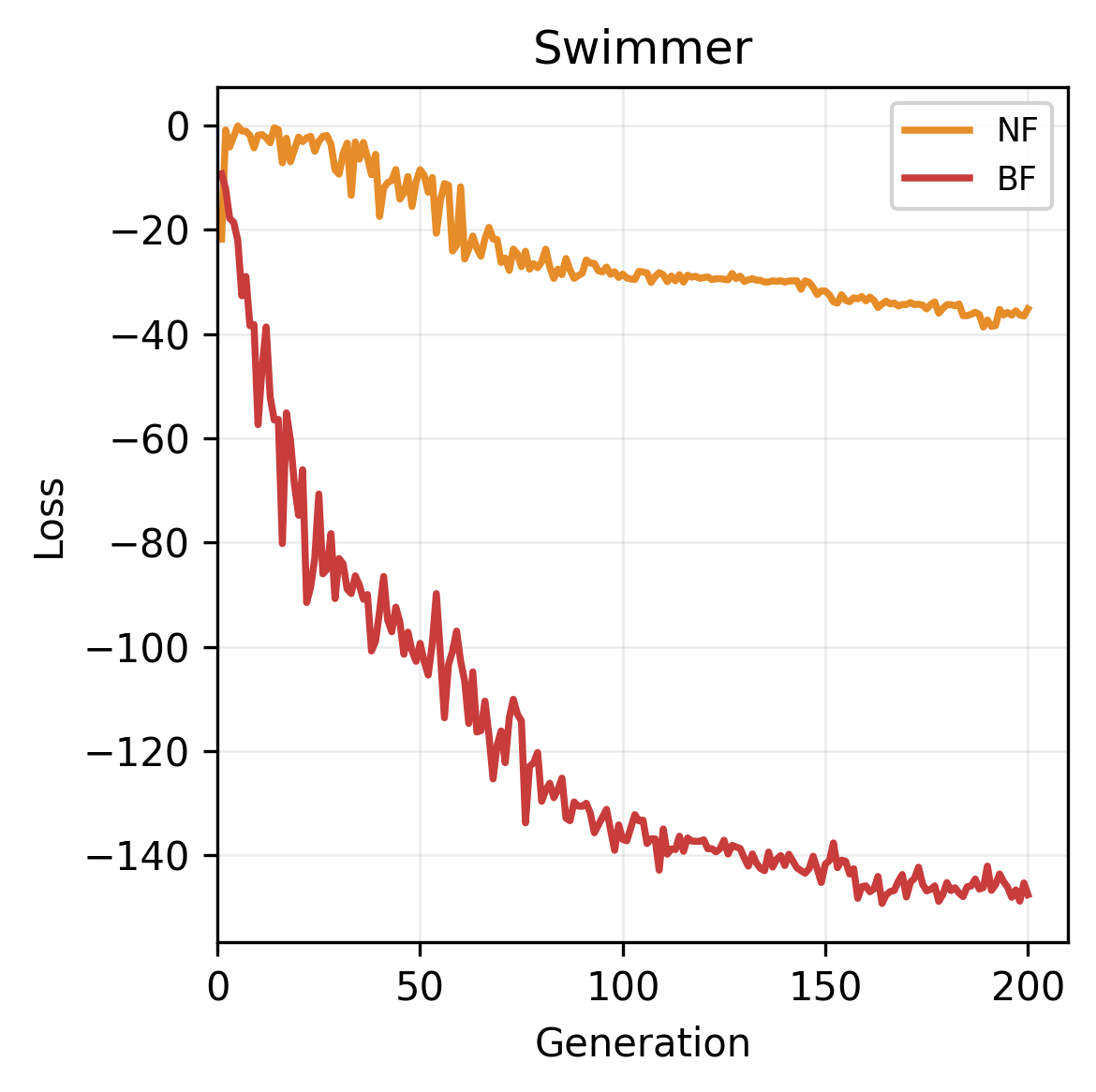
Swimmer — neural field (NF) vs. basis function (BF)
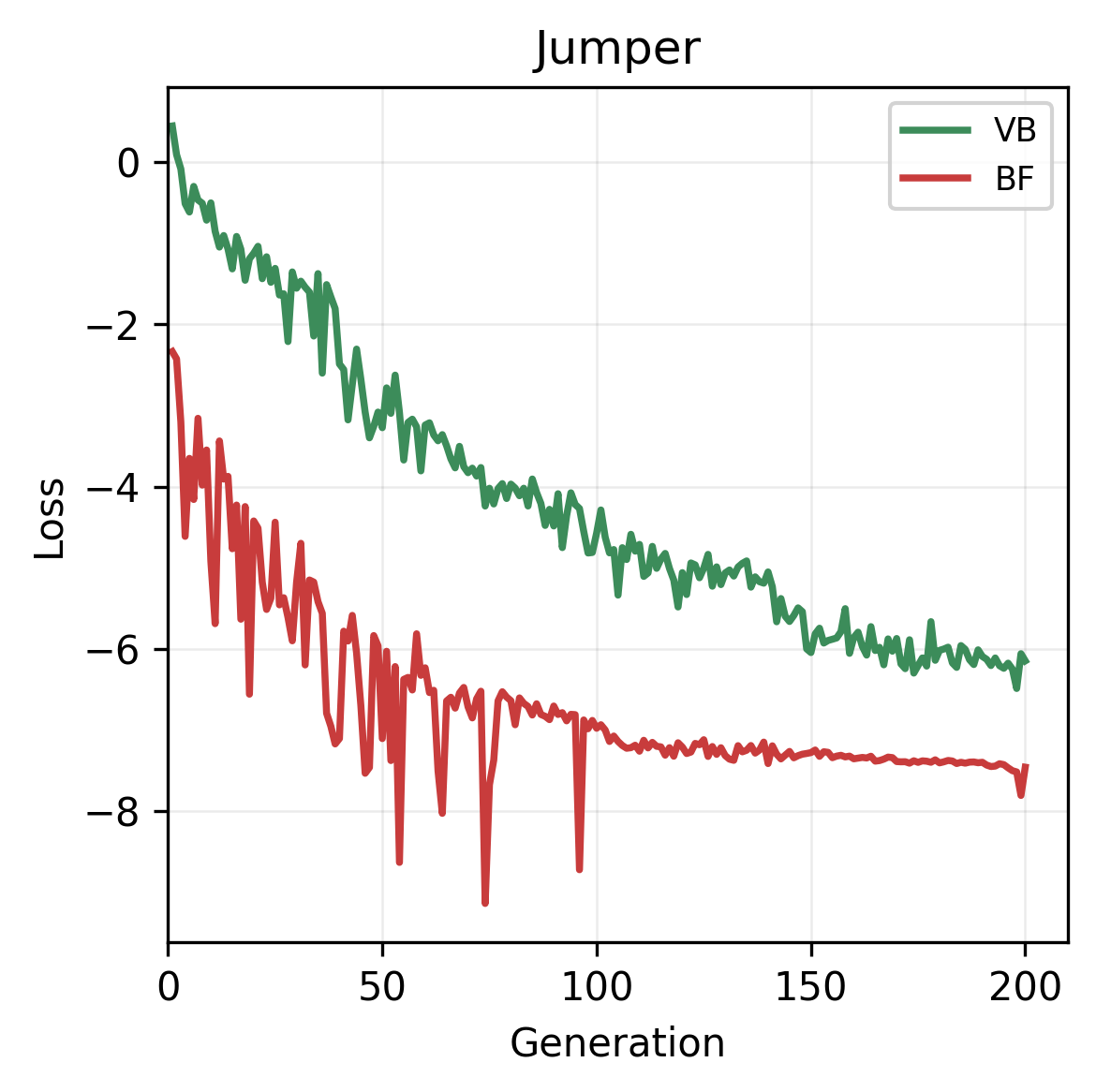
Jumper — per voxel (VB) vs. basis function (BF)
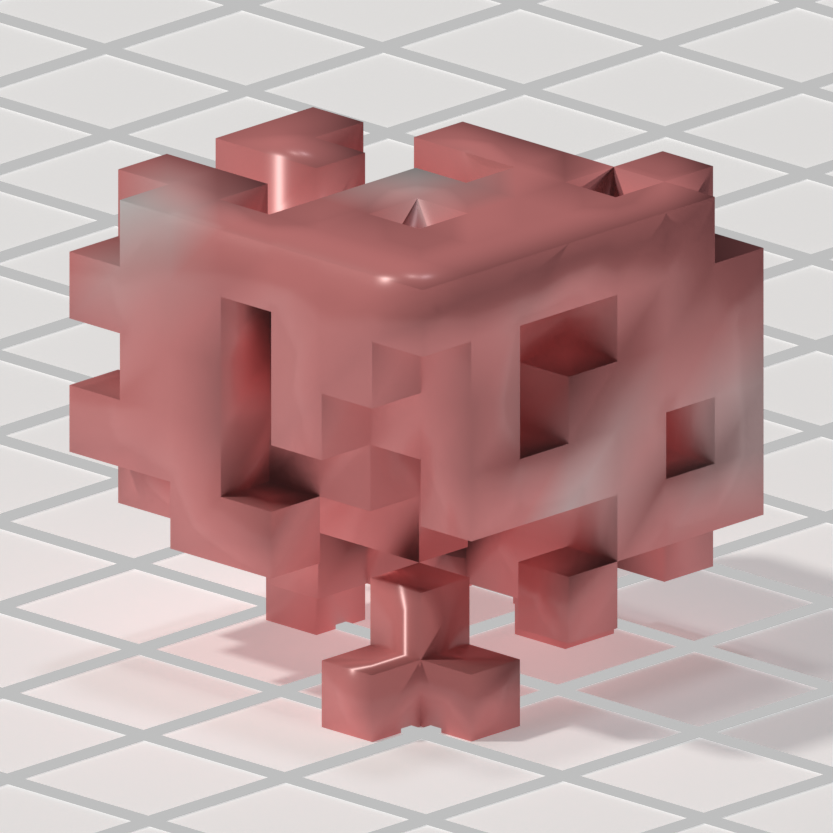
Animated side-by-side rollouts for every comparison above — co-optimization versus sequential optimization, and the basis-function encoding versus its neural-field and per-voxel baselines.
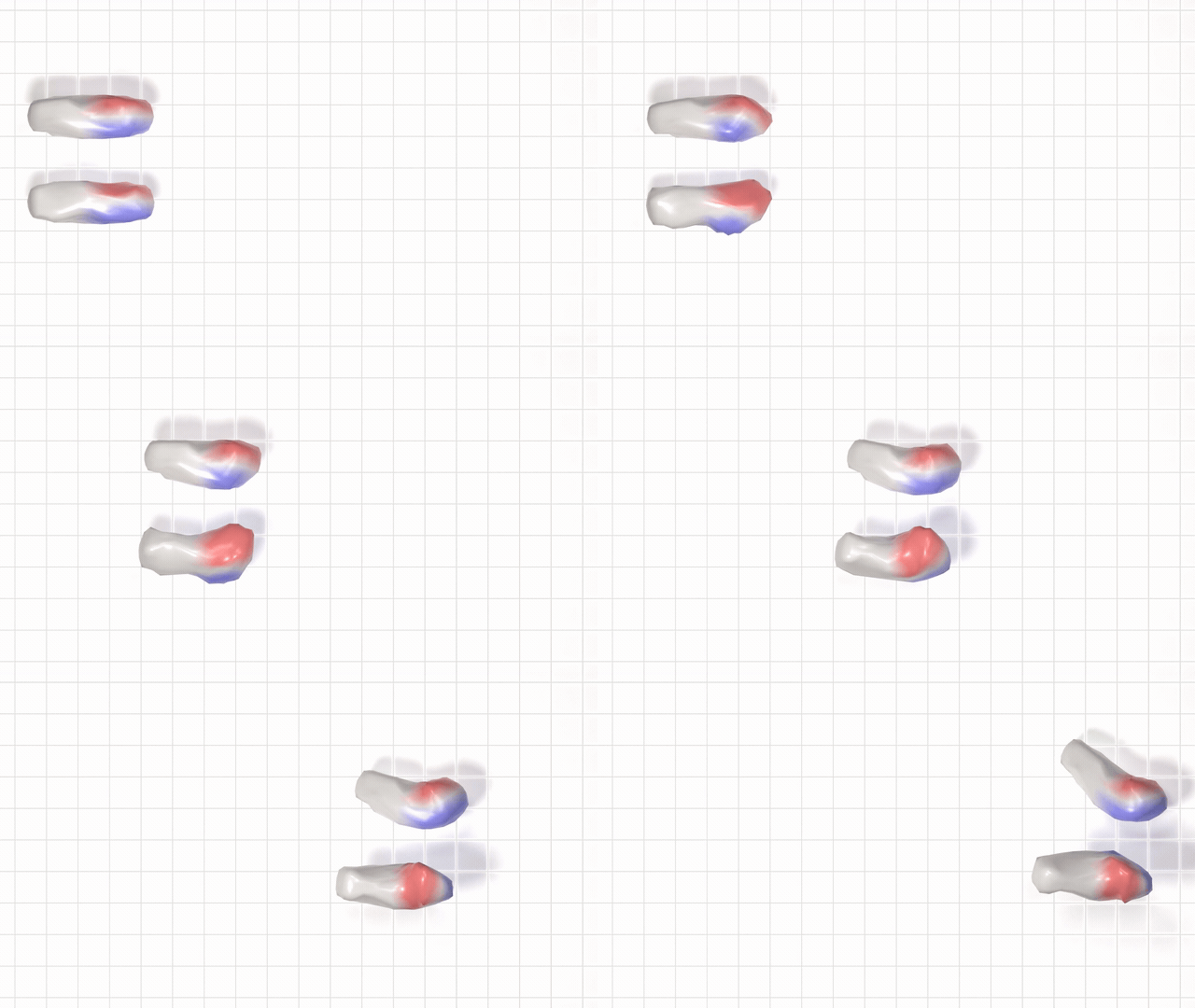
Swimmer: co-optimized vs. sequential.
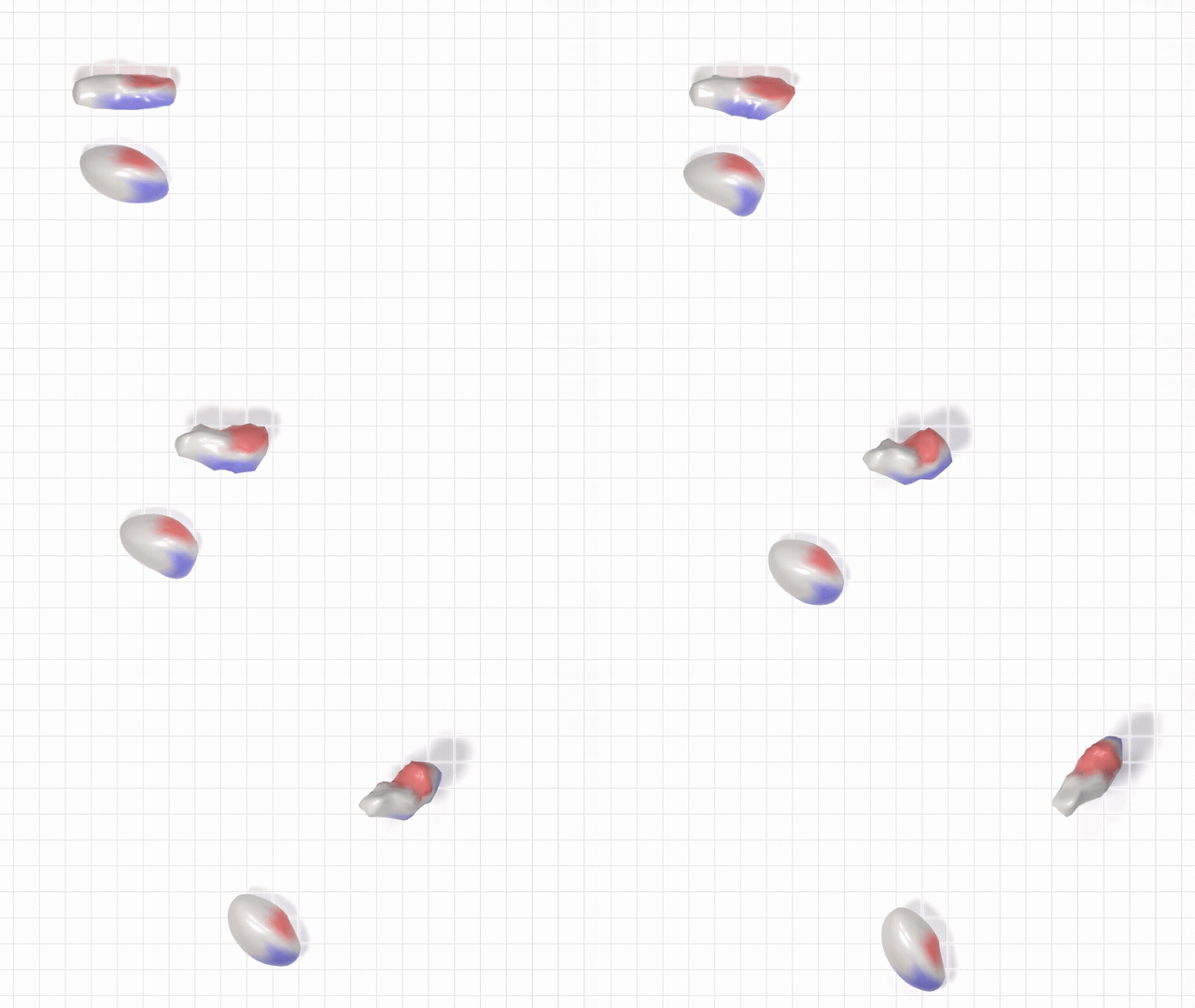
Swimmer: basis function vs. neural field.
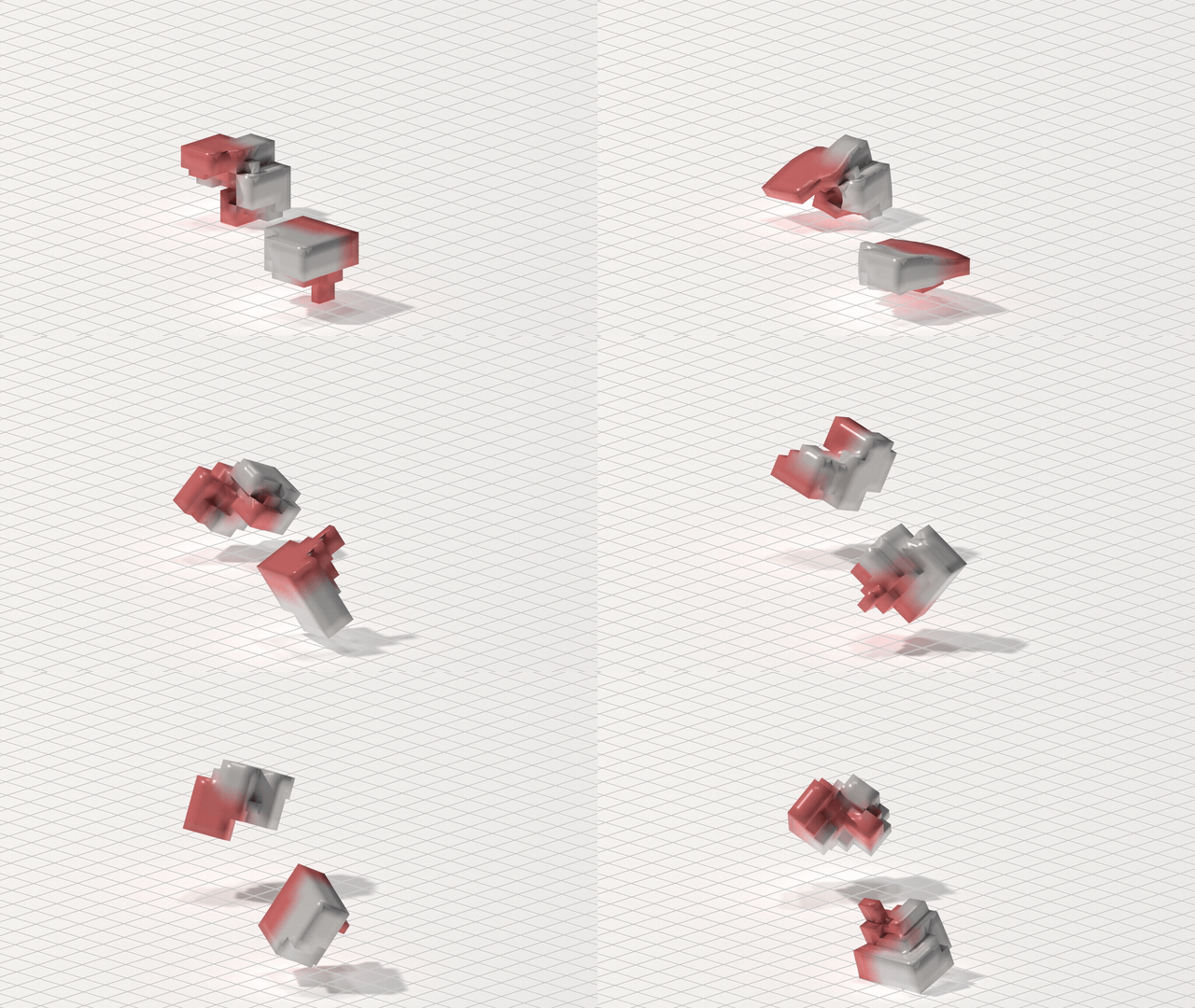
Jumper: co-optimized vs. sequential.
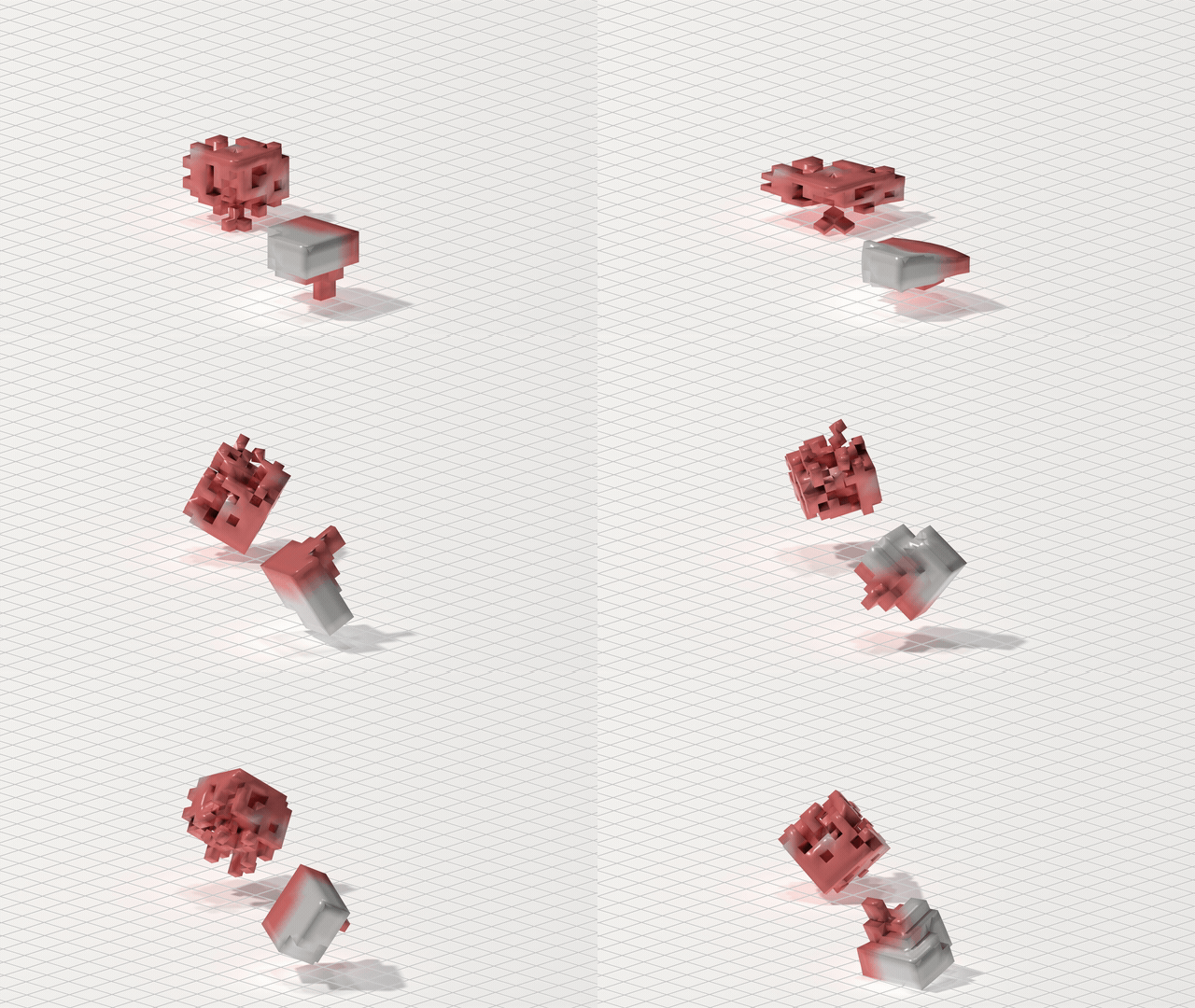
Jumper: basis function vs. per voxel.
@article{candiello2026designembedding,
  author  = {Candiello, Vittorio and Mekkattu, Manuel and Michelis, Mike Y. and Katzschmann, Robert K.},
  title   = {A Unified Low-Dimensional Design Embedding for Joint Optimization of Shape, Material, and Actuation in Soft Robots},
  journal = {arXiv preprint arXiv:2603.06497},
  year    = {2026},
  url     = {https://arxiv.org/pdf/2603.06497}
}