




Fig. 3C
136-dimensional state
Tracking 11 points along the arm instead of 5 raises the state from 58 to 136 dimensions. SoftAE keeps learning quickly to a high return; Random degrades slightly.
Nature Communications · 2026 Accepted
SoftAE lets a soft robot collect its own training data by exploring where its learned dynamics model is least certain. The result is one task-agnostic model that plans new tasks zero-shot.
All at ETH Zurich · *Corresponding author
Real data · replay

Supplementary Movie 1
The overview film walks through the method and all four robots.
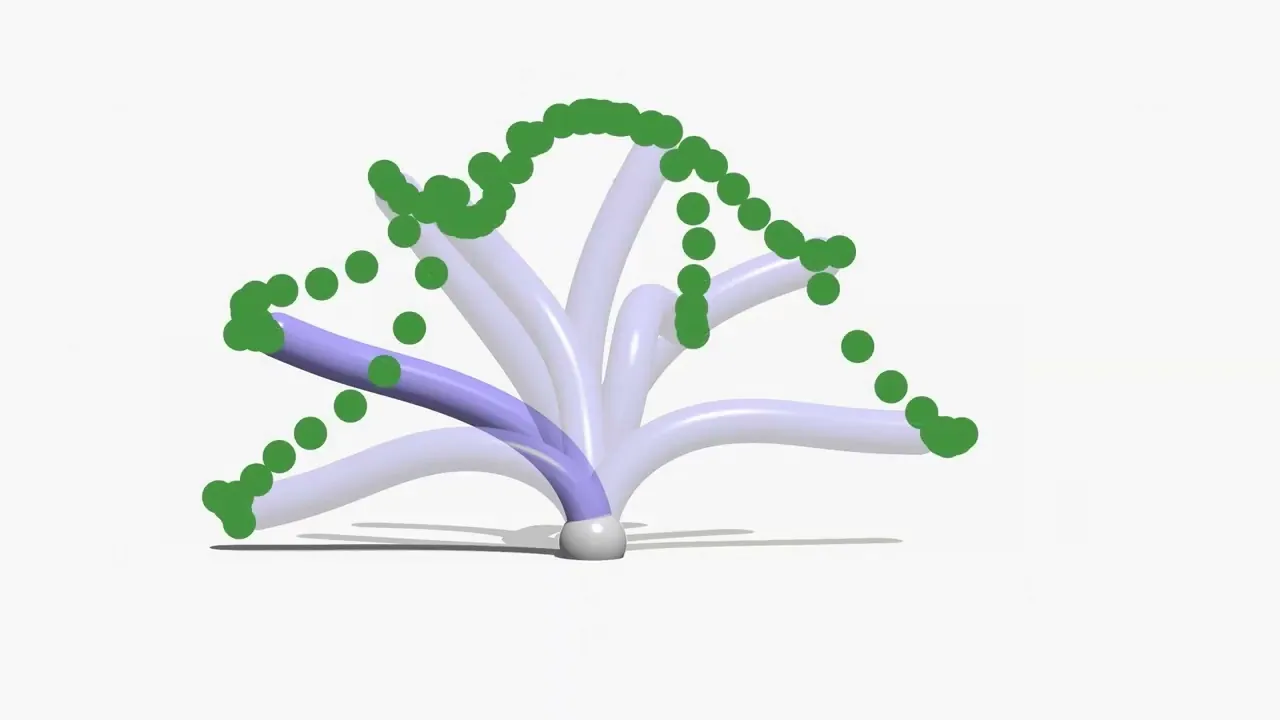 Play the overview video Loads YouTube

01 The idea
Soft bodies deform continuously, so their dynamics are high-dimensional, nonlinear and hard to model from first principles. A learned model is only as general as its data, and how a soft robot gathers that data matters.
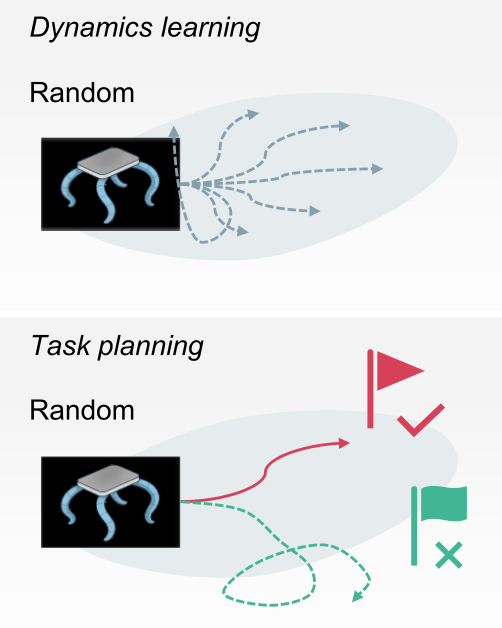
Independent random actions largely cancel out on a compliant body, so data piles up near the rest pose. Tasks that need large deformations stay out of reach.
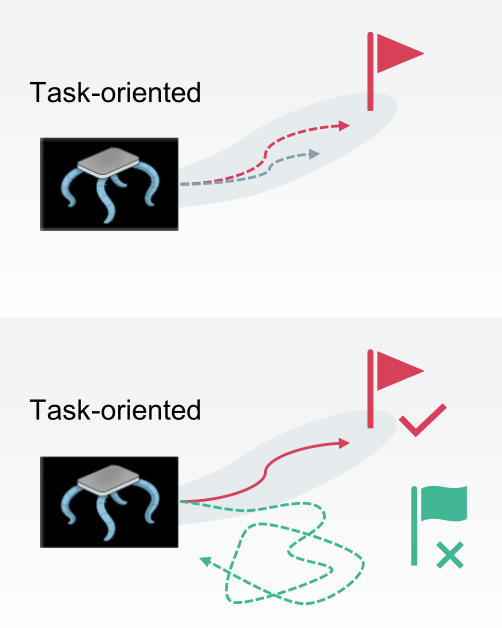
Collecting data along one task’s trajectory gives a model that serves that task and overfits. A new goal falls outside what it has seen.
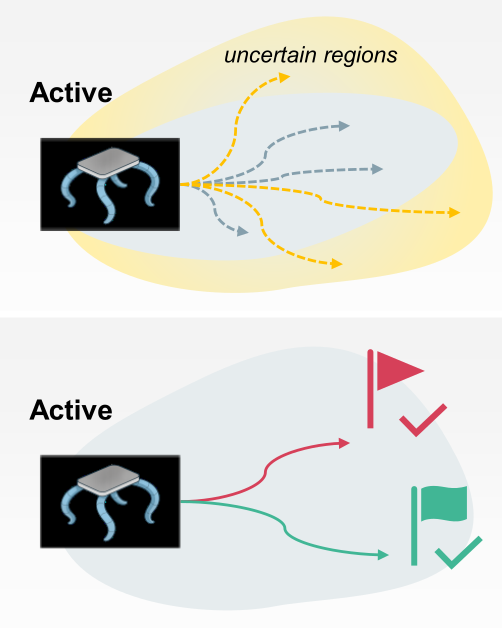
Exploring where the model is uncertain yields diverse, informative data and a task-agnostic model that also solves tasks it never trained for.
Fig. 1E Top row: collecting data. Bottom row: planning a new task with the learned model.
02 How SoftAE works
No task is given during exploration. SoftAE rewards the robot for visiting states where its own dynamics model is unsure, then learns from what it finds there.
Several neural networks are fitted to all data so far. Their mean μ predicts the next state; their disagreement σ measures what the model does not know.
Model-predictive control with iCEM searches for actions, and for plausible dynamics inside μ ± βσ, that collect the most uncertainty along the way.
The robot runs the plan and records what actually happens, in the regions its model knows least about.
New data shrinks the uncertainty there, so the next episode is drawn somewhere new.
Then, zero-shot
Swap the exploration reward for any task reward r(s, a). The same model and the same planner solve the task, with no retraining and no fine-tuning.
Why optimistic planning helps, and the full exploration objective, are in the paper’s Methods .
03 Zero-shot results
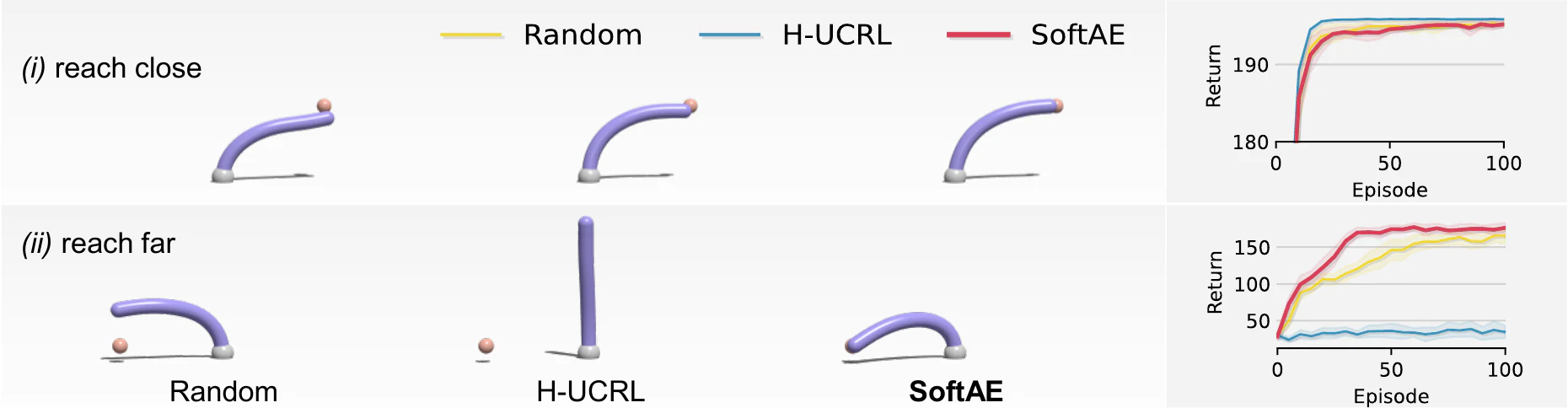
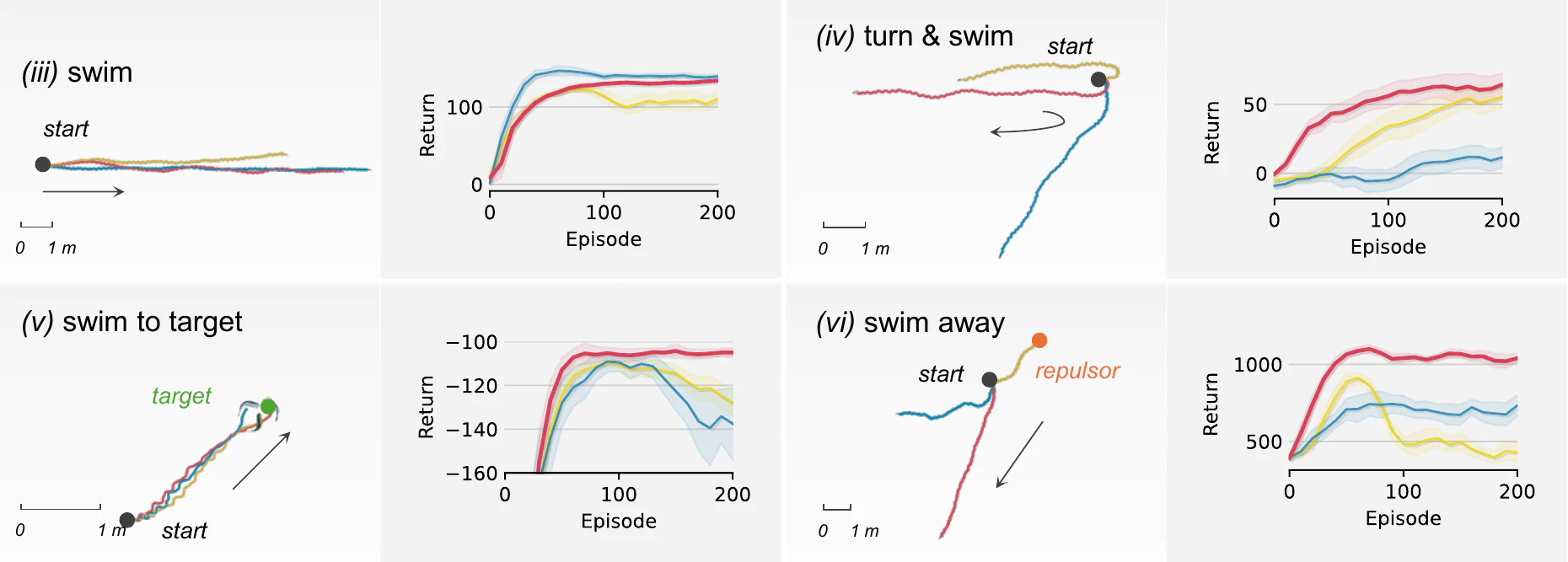
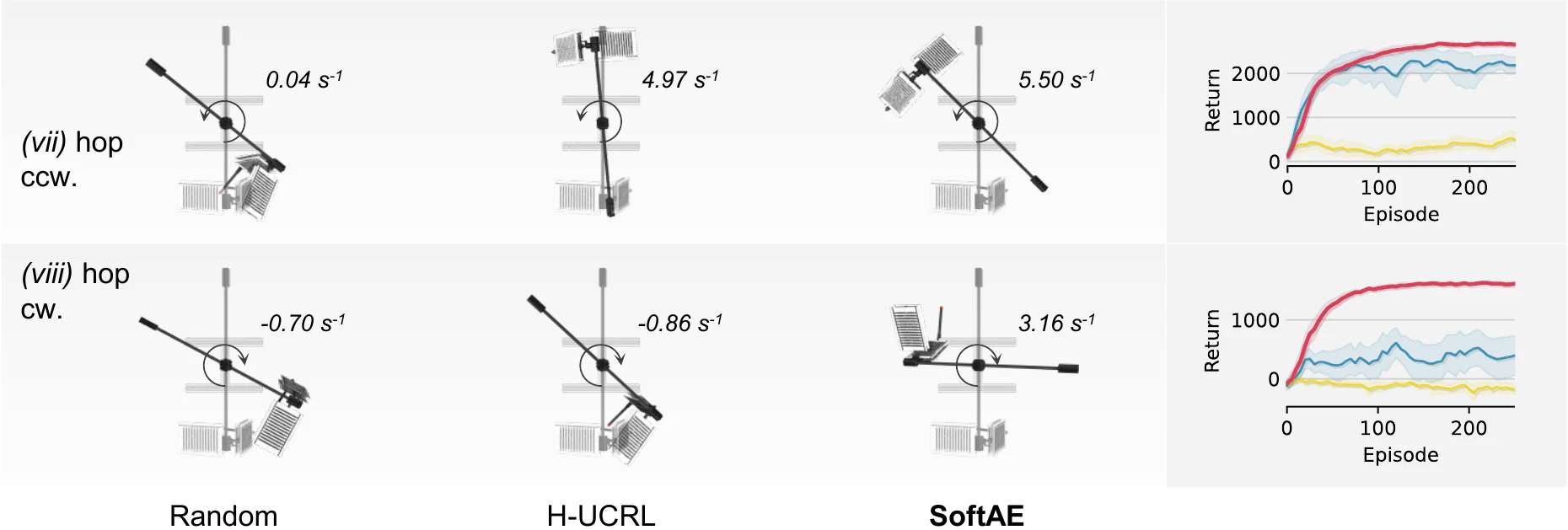
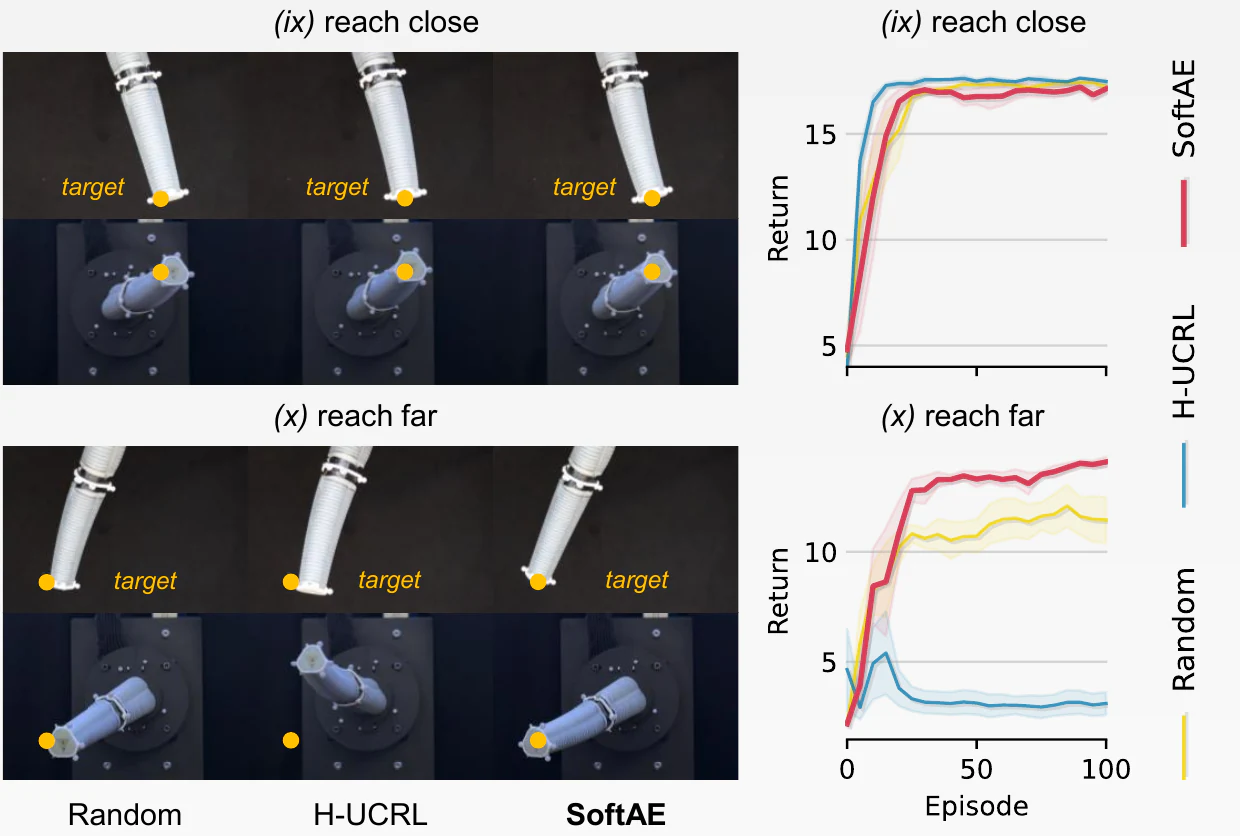
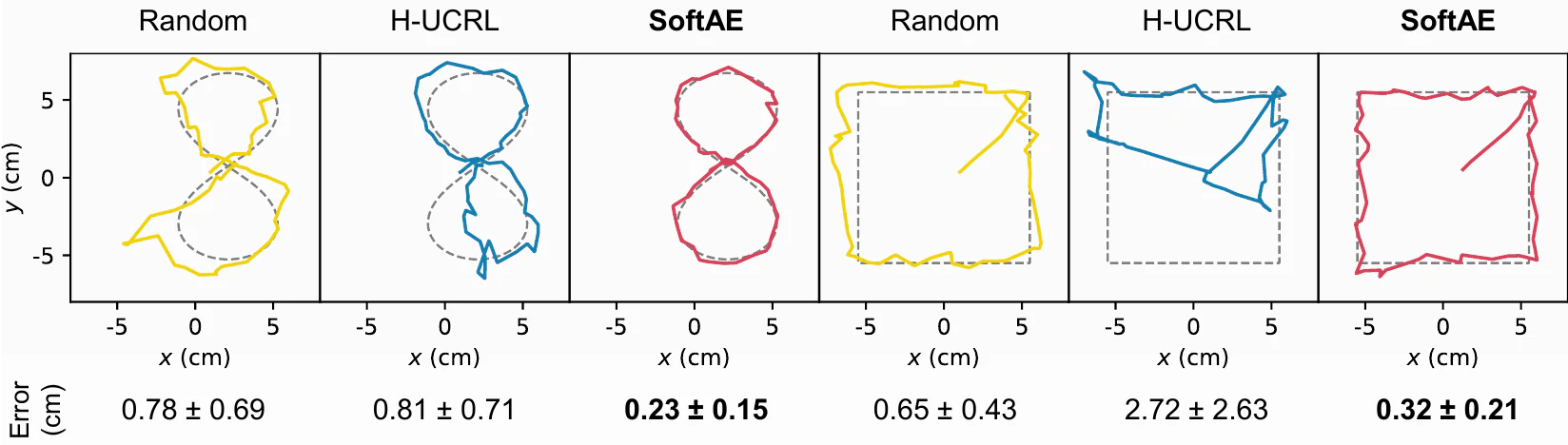
SoftAE and Random never see a task while exploring, so every task below is planned zero-shot. The task-specific baseline H-UCRL trains on tasks (i), (iii), (v), (vii) and (ix); the others are unseen for it too.
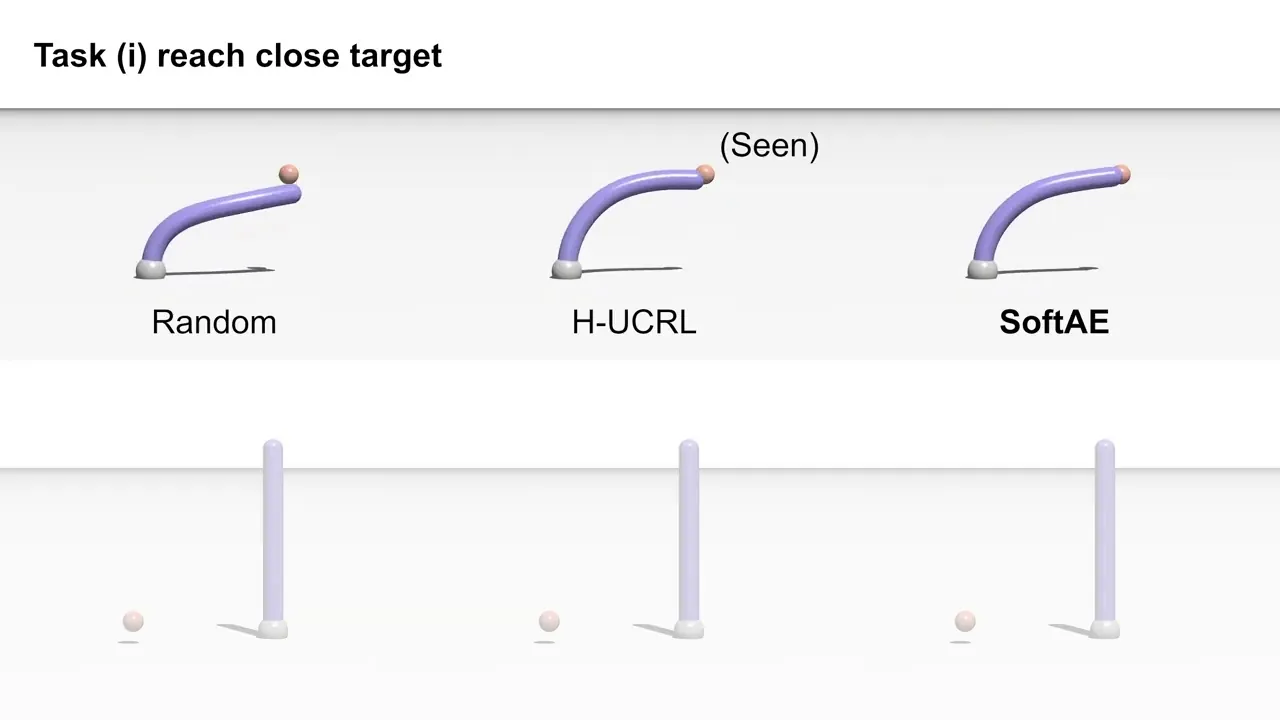 Supplementary Movie 2 Setup, tasks (i)–(ii) and how returns grow with more SoftAE exploration
Reaching the far target (ii) takes extreme bending. The H-UCRL model, trained on the close target, does not generalise there. SoftAE learns it fastest and reaches the highest return.
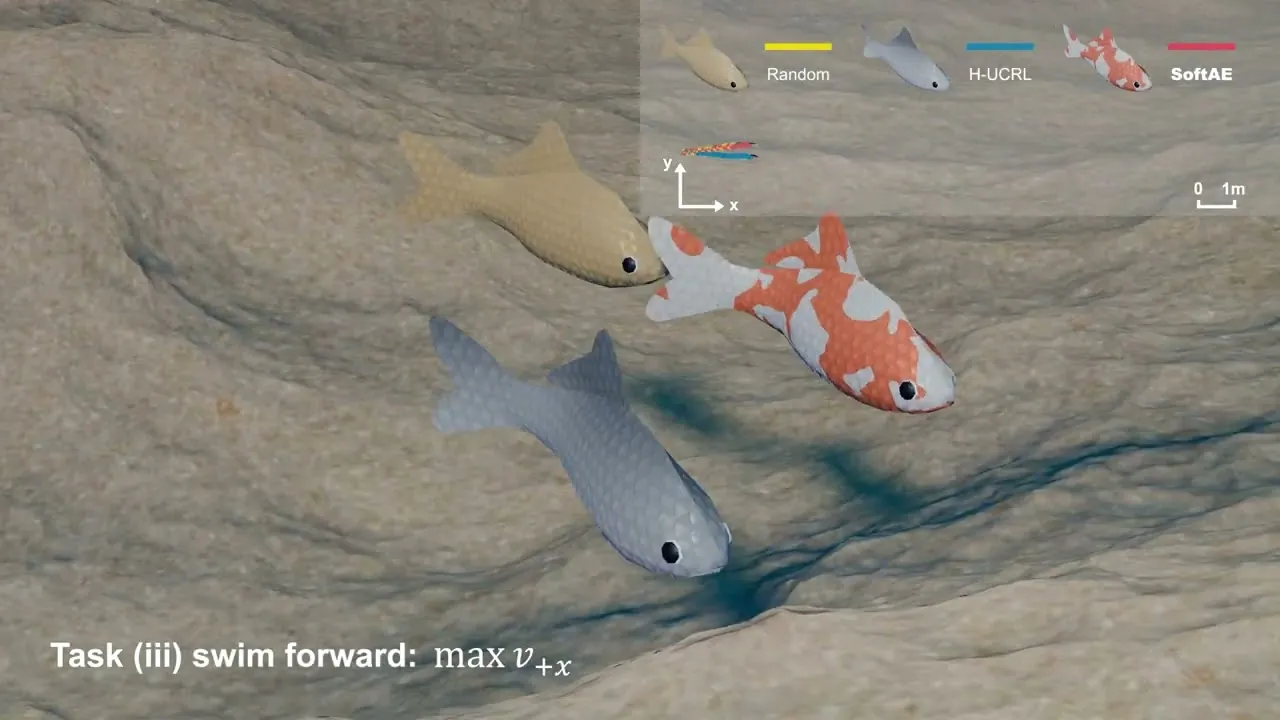 Supplementary Movie 3 Fluid simulation, fluid–structure interaction and swimming tasks (iii)–(vi)
Swimming needs coordinated spine undulation against delayed hydrodynamic feedback. Random rarely produces it and fails on (v)–(vi). SoftAE even beats H-UCRL on (v), a task H-UCRL was trained on.
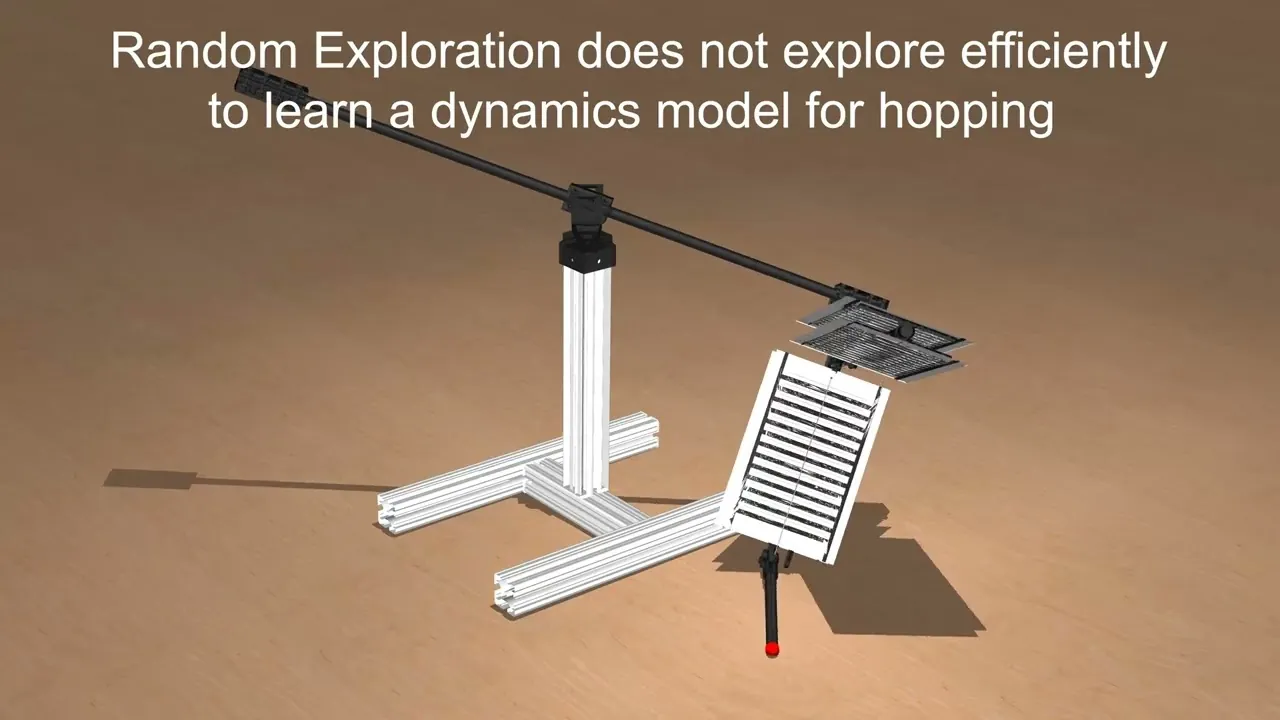 Supplementary Movie 4 Electrohydraulic muscle actuation, setup and hopping tasks (vii)–(viii)
Hopping needs precise muscle–motor coordination and ground-contact timing, which random exploration does not discover. SoftAE hops in both directions and beats H-UCRL even on (vii), its training task.
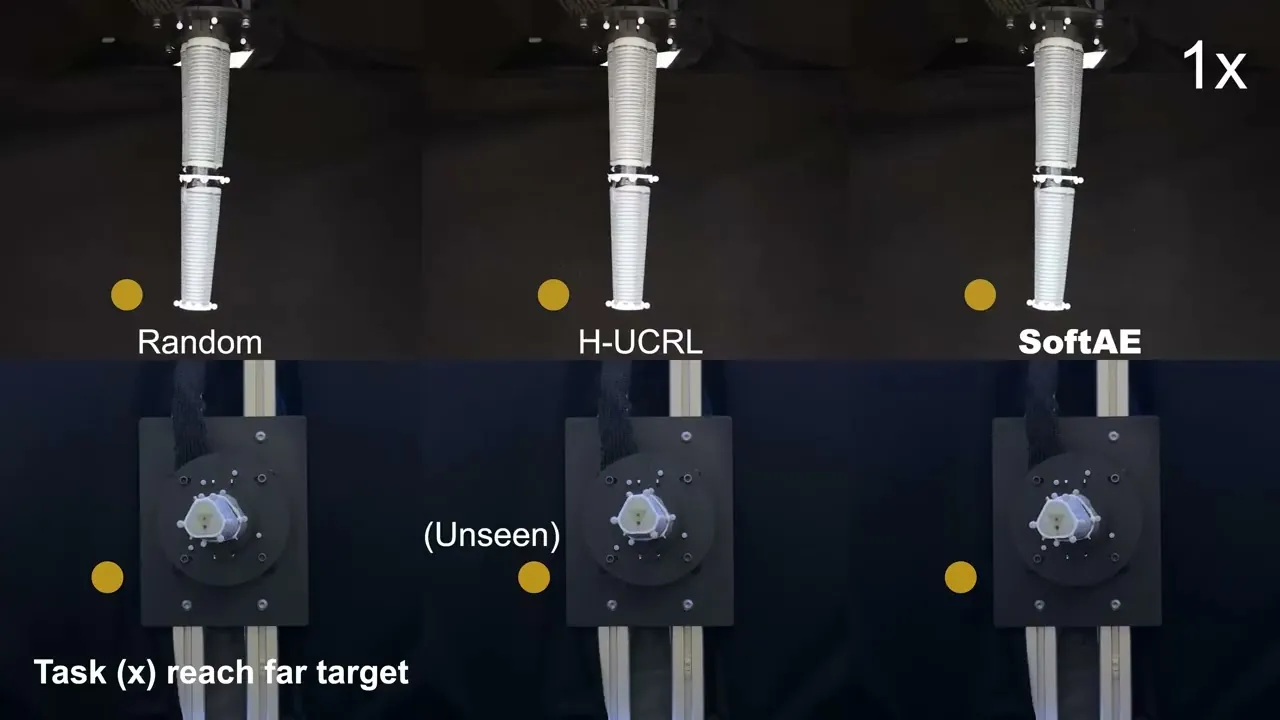 Supplementary Movie 5 Real-world setup and task performance, Fig. 4 in motion
On hardware, sensing noise, actuation delays, hysteresis and pneumatic variability all come into play, and exploration and planning stay the same. Near the edge of the workspace SoftAE outperforms both baselines, and across 20 random 3-D targets its mean tip error is 2.00 mm.
Model-free is not an option at this budget. Goal-conditioned SAC trained directly on the arm made no progress after 40,000 real transitions, about 12 hours and twice the data the model-based methods used (Supplementary Fig. 5).
04 Stress tests
The same exploration loop holds up when the state gets much larger, and when the soft arm has to work around rigid obstacles.
Fig. 3C
Tracking 11 points along the arm instead of 5 raises the state from 58 to 136 dimensions. SoftAE keeps learning quickly to a high return; Random degrades slightly.
Fig. 3D
A model trained without obstacles predicts the arm passing straight through one. Trained among obstacles, it reproduces the contact-induced deformation over a 10-step rollout.
Fig. 3E
Reaching under a bar, or through a gap at the base of a wall, needs coordinated deformation. Only SoftAE consistently succeeds at both.
Beyond model-predictive control. With policies trained on model rollouts (an MBPO variant using SAC), SoftAE matches task-specific MBPO on its training task and outperforms it on unseen ones (Supplementary Fig. 4).
05 Paper & code
Learning Soft Robotic Dynamics with Active Exploration
Nature Communications (2026), accepted, in press · Preprint arXiv:2510.27428
Soft robots offer adaptability and safety in unstructured environments, yet their compliant, high-dimensional, and nonlinear dynamics make modeling for control difficult. Existing data-driven approaches often fail to generalize, constrained by narrowly focused task demonstrations or inefficient random exploration. We introduce an uncertainty-aware active exploration framework that autonomously learns task-agnostic and generalizable dynamics models of soft robotic systems. We evaluate this framework on three simulated platforms—a continuum arm, an articulated fish in fluid, and a musculoskeletal leg—and on a real-world pneumatically actuated continuum arm. Compared with random exploration and task-specific baseline, our method achieves higher modeling accuracy by actively collecting informative data. This improved model quality yields higher returns in zero-shot control on unseen tasks and robust performance under sensing noise, actuation delays, and material nonlinearities. These results demonstrate that uncertainty-driven active exploration enables data-efficient dynamics learning across soft robotic morphologies, supporting autonomous and adaptable control for compliant robots.
@misc{zheng2025learningsoftroboticdynamics,
  title         = {Learning Soft Robotic Dynamics with Active Exploration},
  author        = {Hehui Zheng and Bhavya Sukhija and Chenhao Li and
                   Klemens Iten and Andreas Krause and Robert K. Katzschmann},
  year          = {2025},
  eprint        = {2510.27428},
  archivePrefix = {arXiv},
  primaryClass  = {cs.RO},
  url           = {https://arxiv.org/abs/2510.27428}
}
Questions about the work?