01 / RECOVER
Down, but not out.
After a fall, a dedicated recovery policy brings the hand back onto its fingertips.
21/25successful hardware recoveries
84% across two fall directions
84% across two fall directions
 FINGERS AS LEGS.


Learning Self-Supported Locomotion and Manipulation
with an Anthropomorphic Hand
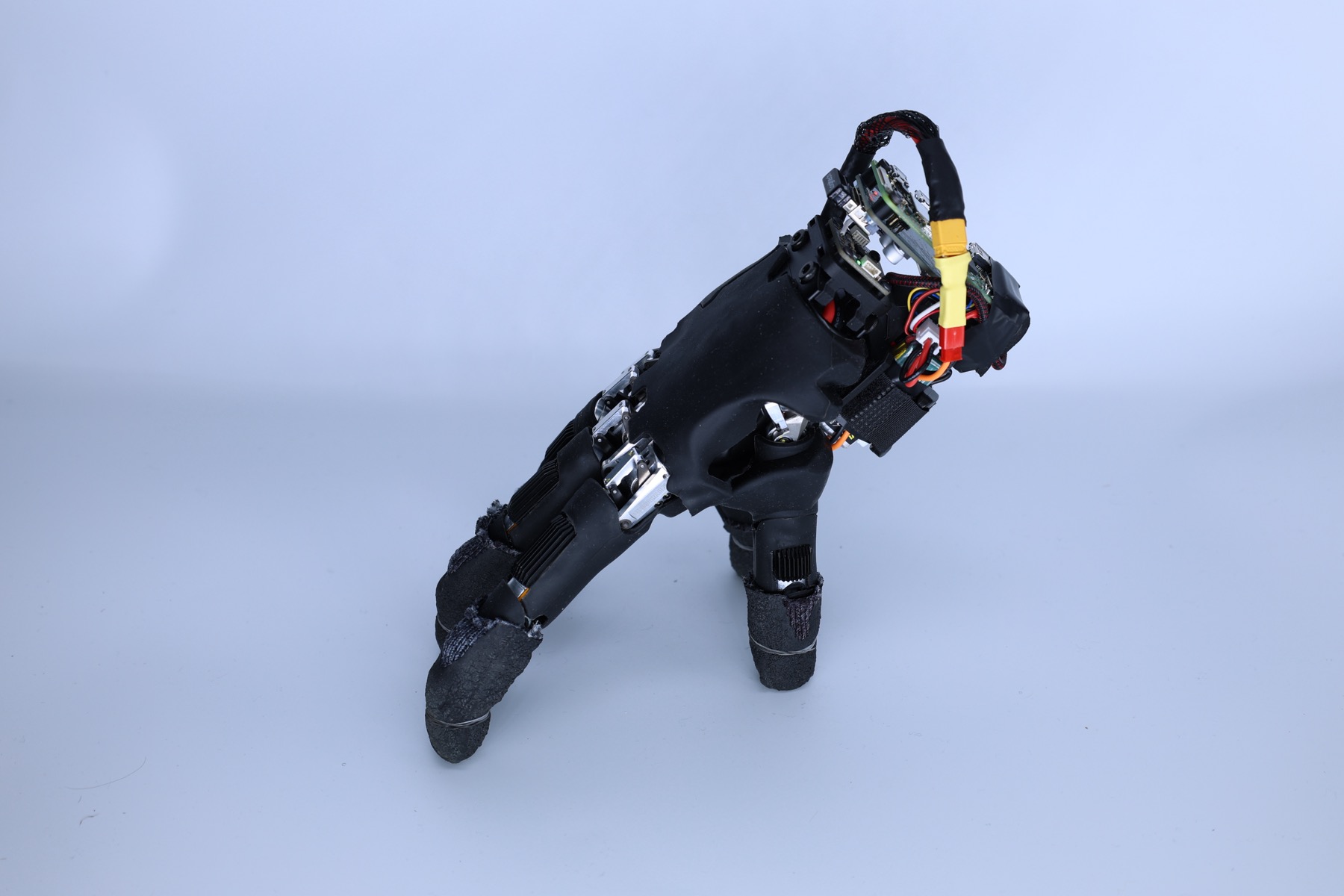
An off-the-shelf robotic hand learns to walk, support itself and interact with the world using the fingers it already has.
01 / THE PLATFORMThe original finger design and built-in joint controller stay. A compact module adds power, sensing, and a computer.
02 / THE CHALLENGELift one finger to step or press a key, and the others must still support the whole hand.
03 / THE APPROACHThe hand learns through trial and error in a calibrated simulator, then runs the learned policy onboard.
From the first steps to self-supported interaction.
Watch on YouTube ↗Untethered crawling, demonstrated on 14 indoor and outdoor surfaces. No wheels. No extra legs. Just a hand getting on with it.
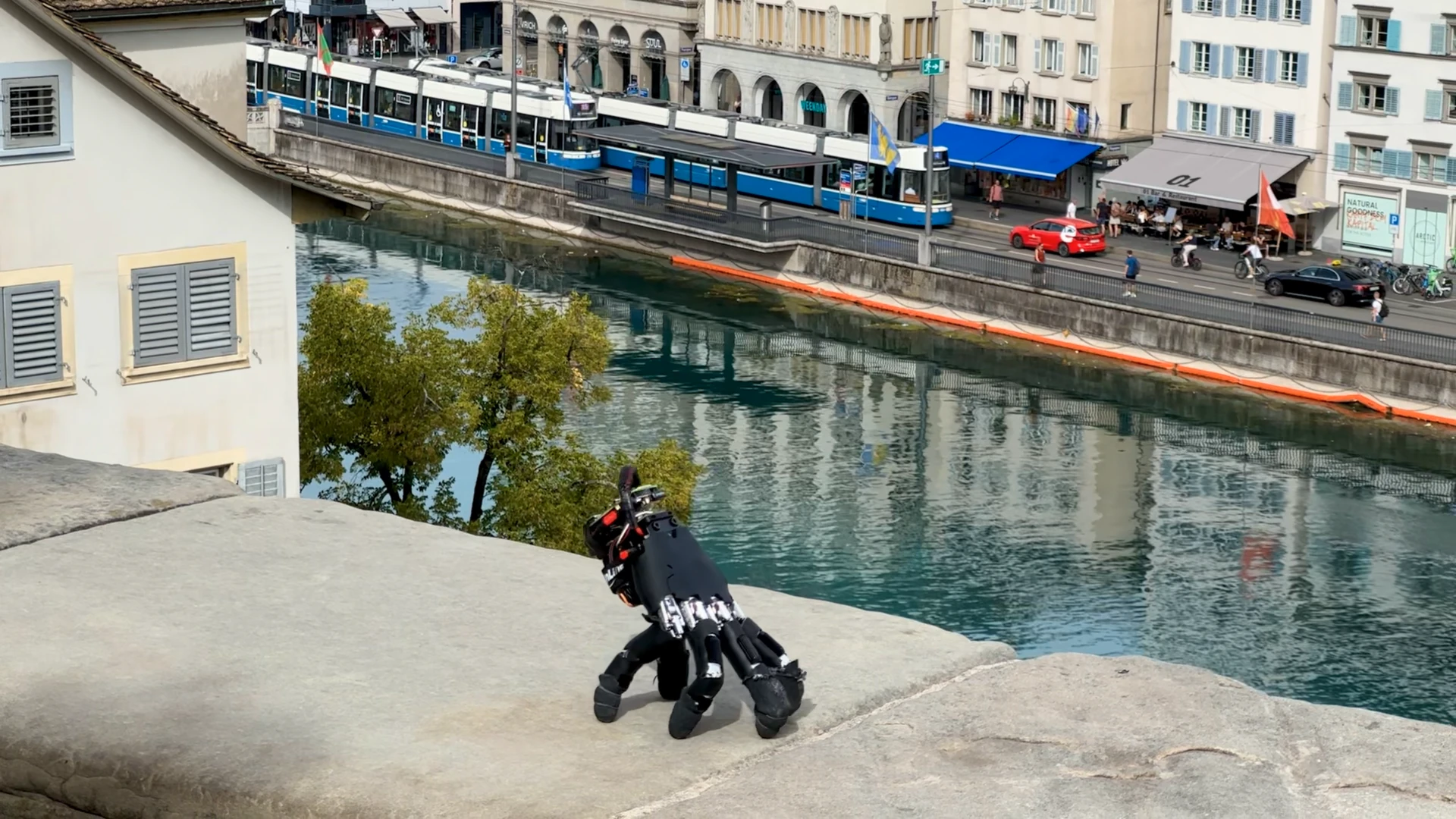
Rubber mat · Carpet · Tile · Metal grating · Asphalt · Dry concrete · Cut stone · Artificial turf
The hand can also recover after a fall, press keys and push objects while supporting its own weight.
After a fall, a dedicated recovery policy brings the hand back onto its fingertips.
Successive key presses execute operator-issued Sokoban moves, without visual feedback.
With overhead visual feedback, the hand approaches and pushes a cube to a target.
Each skill uses its own policy. Keyboard trials start with manual alignment. Steering remains asymmetric.
The actor learns to move through trial and error. A critic with extra simulator information helps train it.
Joint angles, tilt, rotation rate and previous outputs, plus a movement command.
Turns sensor history and commands into 20 joint-target adjustments.
The built-in controller moves the simulated hand toward those targets.
New readings feed the next action.Body state, joint torques and fingertip contact forces from the simulator.
Estimates the future reward expected from the current state.
Helps PPO compare outcomes with expectations.
Collected experience
+ rewards + critic estimates
Update actor + criticThen collect another batch.
Asymmetric: the critic gets extra simulator information during training.
Eight recent observations give the actor a short history of the hand’s motion.
Eight samples of 49 inputs form a 392-value observation. A feedforward network with hidden layers of 512, 256 and 128 units produces 20 joint-target adjustments.
Training uses 4,096 parallel environments. Proximal Policy Optimization (PPO) uses a clipped objective to discourage overly large policy updates.
Architecture and training in the paper, Secs. III–IVRewards guide the learning. Explore one of them: a virtual-spring preference for each fingertip.
See the reference move with the body.
The ring marks this fingertip’s reference in the settled stance. Each finger has its own.
This reference moves with the body.
Stretching a virtual spring adds a training cost. Forward–backward movement costs less than sideways or upward movement.
Forward: a softer virtual spring.
Relative units. Compare directions at the same distance.Reference positions, movement speed and stepping pace.
Which finger lifts when, and how far it moves.
Compare an earlier and a later lift at the same pace.
Each fingertip has a fixed reference relative to the body in a frame calibrated to the settled stance. This frame removes the nominal palm tilt, then rotates with the body.
Cost per finger = 0.25 × forward² + sideways² + vertical²
Displacements are measured from each fingertip’s reference. The five costs enter the reward with weight −30.
The lift objective encourages a pace that increases with commanded speed. Direction shaping discourages airborne motion against the command.
Read the formulation in the paper, Sec. IVIn simulation, our formulation produced faster movement than tuned rewards for four-legged robots.
Difference: +0.65 cm/s · 95% CI [+0.26, +1.02]
256 randomized episodes per seed. See paper, Sec. VI-A.
Fingers as Legs: Learning Self-Supported Locomotion and Manipulation with an Anthropomorphic Hand
 VIEW THE PAPER
 A walking robotic hand must use the same fingers to move its body, support its weight, and interact with the environment. We show how an anthropomorphic hand can learn these skills while retaining its finger design and position controller. Onboard power and computation make the platform self-contained. Our reinforcement learning approach accounts for the hand's unequal fingers, with training in a simulator calibrated from hardware measurements. In simulation, the hand moves faster with our reward formulation than with tuned rewards originally designed for quadrupeds. On hardware, task-specific policies enable untethered crawling, steering, and fall recovery. While supporting its own weight, the hand also executes successive keyboard commands without vision and pushes an object to targets using overhead visual feedback. These results demonstrate a compact mobile manipulator that reuses its fingers for locomotion and interaction, without a separate locomotion mechanism.
@misc{kazemipour2026fingers,
  title  = {Fingers as Legs: Learning Self-Supported Locomotion
            and Manipulation with an Anthropomorphic Hand},
  author = {Kazemipour, Amirhossein and Zheng, Hehui
            and Katzschmann, Robert},
  year   = {2026},
  eprint = {2609.17172},
  archivePrefix = {arXiv},
  primaryClass = {cs.RO},
  url    = {https://arxiv.org/abs/2609.17172}
} — Read coverage (opens in a new tab)
 — Read coverage (opens in a new tab)
 — Read coverage (opens in a new tab)
 — Read coverage (opens in a new tab)
 — Read coverage (opens in a new tab)
 — Read coverage (opens in a new tab)
 — Read coverage (opens in a new tab)
 Hackaday — Read coverage (opens in a new tab)
 Think — Read coverage (opens in a new tab)
For editorial coverage, we can provide high-resolution images and original video footage.