

Overview video
A narrated tour of the method
Abstract
Decoupling dynamics from rendering
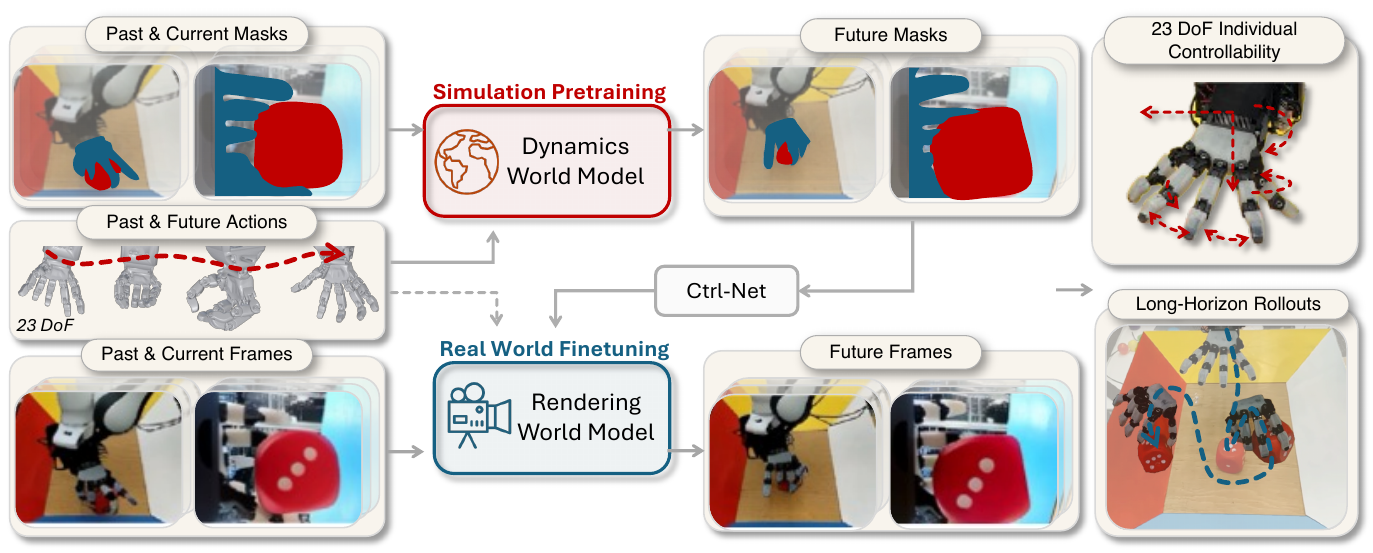
Action-conditioned world models let robots imagine the future consequences of their actions without physical interaction, making them a powerful tool for policy evaluation, planning, and data augmentation. We present Mask2Real-WM, a two-stage action-conditioned world model for dexterous manipulation that decouples pixel prediction into a dynamics model and a rendering model.
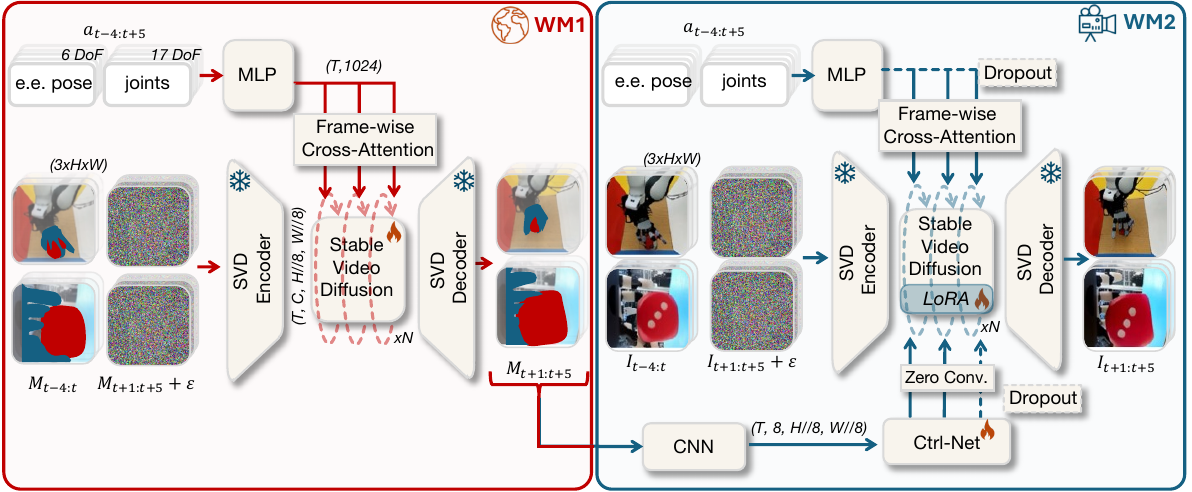
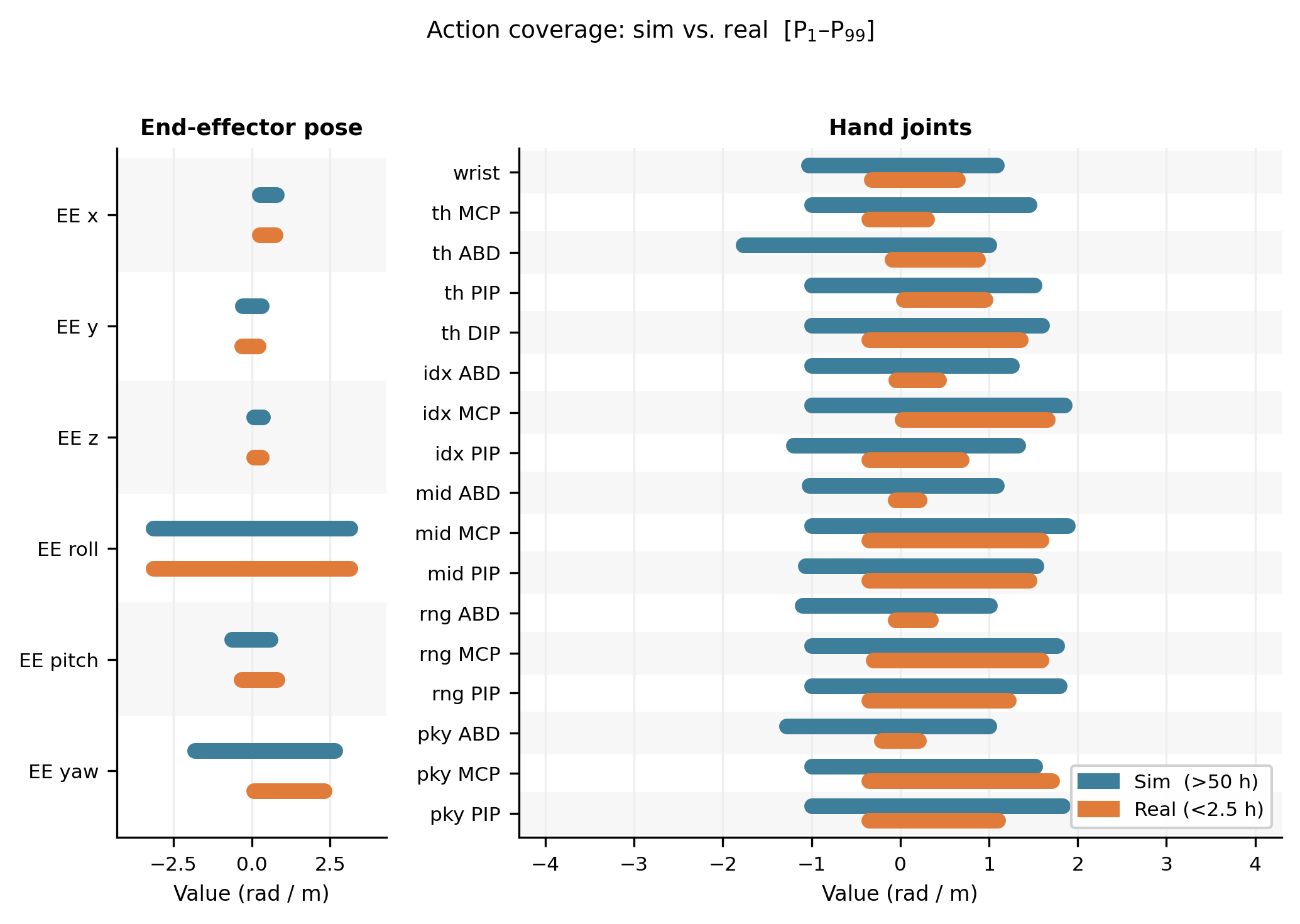
The dynamics model predicts future segmentation masks from past masks and a 23-dimensional action sequence (a 6-D Cartesian end-effector pose and 17 hand-joint positions); the rendering model paints photorealistic RGB onto the predicted masks via a ControlNet-augmented SVD backbone. Because segmentation space has a small sim-to-real gap, the dynamics model benefits from large-scale midtraining on over 50 h of synthetic simulation data followed by fine-tuning on approximately 2.5 h of real demonstrations (an avenue underexplored for image-space world models).
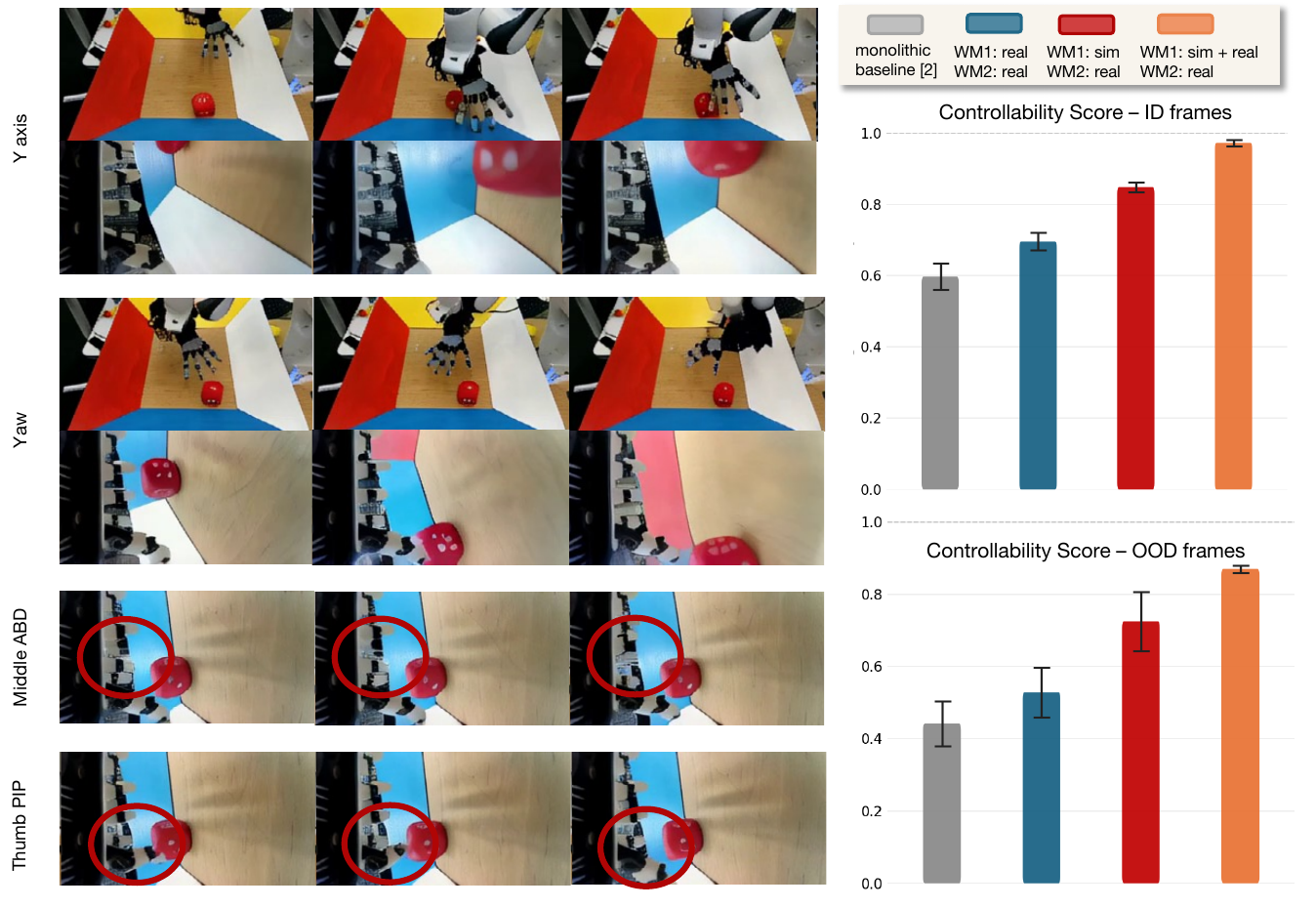
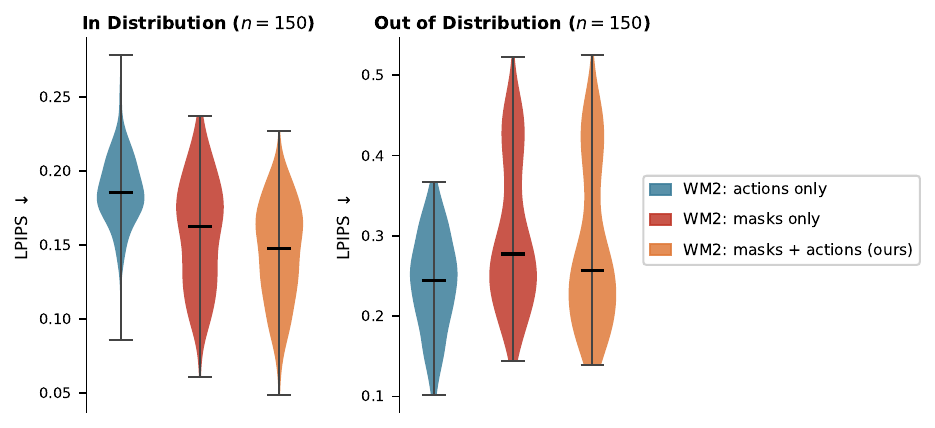
Experiments on a dexterous pick-and-place benchmark show that both mask conditioning and simulation midtraining are necessary to achieve high mean command-response controllability across the 23 action dimensions, while monolithic baselines capture only coarse end-effector motion.
Action space
6DEE pose + 17handjoints = 23actiondims
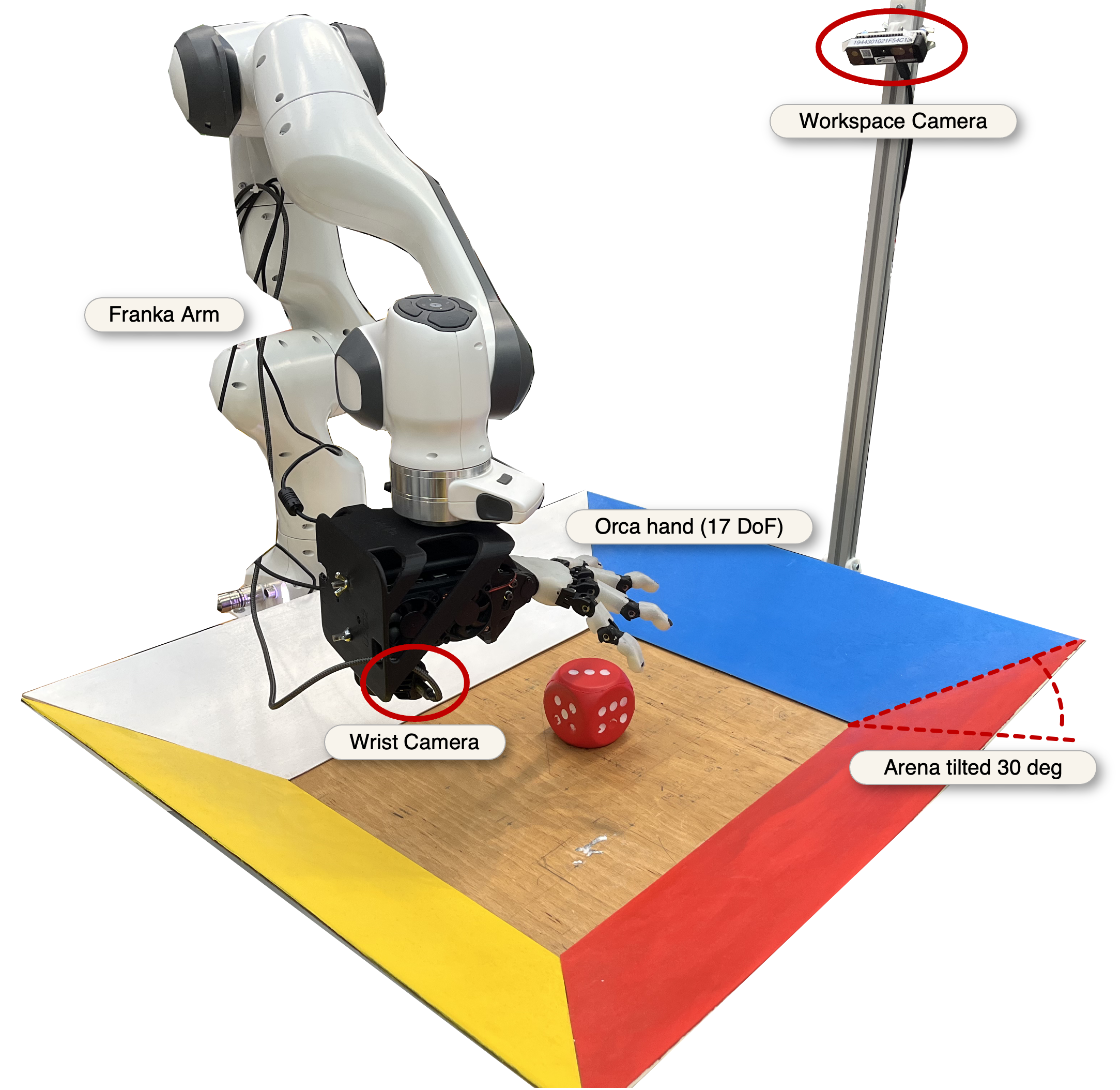
A 6-D Cartesian end-effector pose and 17 ORCA hand-joint positions are driven as one action sequence: every action dimension conditions the dynamics model directly, rather than through a coarse end-effector proxy. (The physical robot has 24 actuated joint DoF: 7 in the arm, 17 in the hand; the arm is commanded in Cartesian end-effector space.)
- Synthetic midtraining
- >50 hIsaacLab simulation
- Real demonstrations
- ≈2.5 hFine-tuning budget
- ID controllability
- 0.95vs. 0.60 baseline
Key idea
Decouple what moves where from what it looks like
Predicting dexterous manipulation in raw pixels forces a single model to learn both physics and appearance at once, and the sim-to-real appearance gap blocks the use of cheap synthetic data. Mask2Real-WM instead factorizes the problem into one shared system of two stages, chained autoregressively at inference:
WM1 · Dynamics
Masks from actions
An action-conditioned video-diffusion model (SVD backbone) predicts future segmentation masks from past masks and the 23-DoF action sequence. Masks have a tiny sim-to-real gap, so WM1 is midtrained on >50 h of IsaacLab data, then fine-tuned on real data with LoRA.
WM2 · Rendering
RGB from masks
A ControlNet-augmented SVD backbone paints photorealistic two-view RGB onto WM1's predicted masks. Trained on real data only (≈2.5 h), since appearance is where the sim-to-real gap is largest. A lightweight CNN encodes masks before ControlNet injection.
Segmentation as a bridge
Masks have a substantially smaller sim-to-real gap than RGB, enabling synthetic midtraining that is impractical in RGB space.
Command-response controllability
High mean command-response controllability across the 23 action dimensions, with substantially reduced coupling versus the monolithic baseline.
Automatic labels
SAM 3 produces segmentation pseudo-labels without manual per-frame annotation (wrist view initialized with a short auxiliary clip and a bounding box), supervising the intermediate representation at scale.
Method
A two-stage world model, told as a picture
Interactive demo
Per-dimension controllability, in 3D
Click any joint on the 3D ORCA hand (or a button) to see the world model's prediction when that single action dimension is perturbed. Switch models and samples to compare side by side.
Results
What mask conditioning and sim midtraining buy
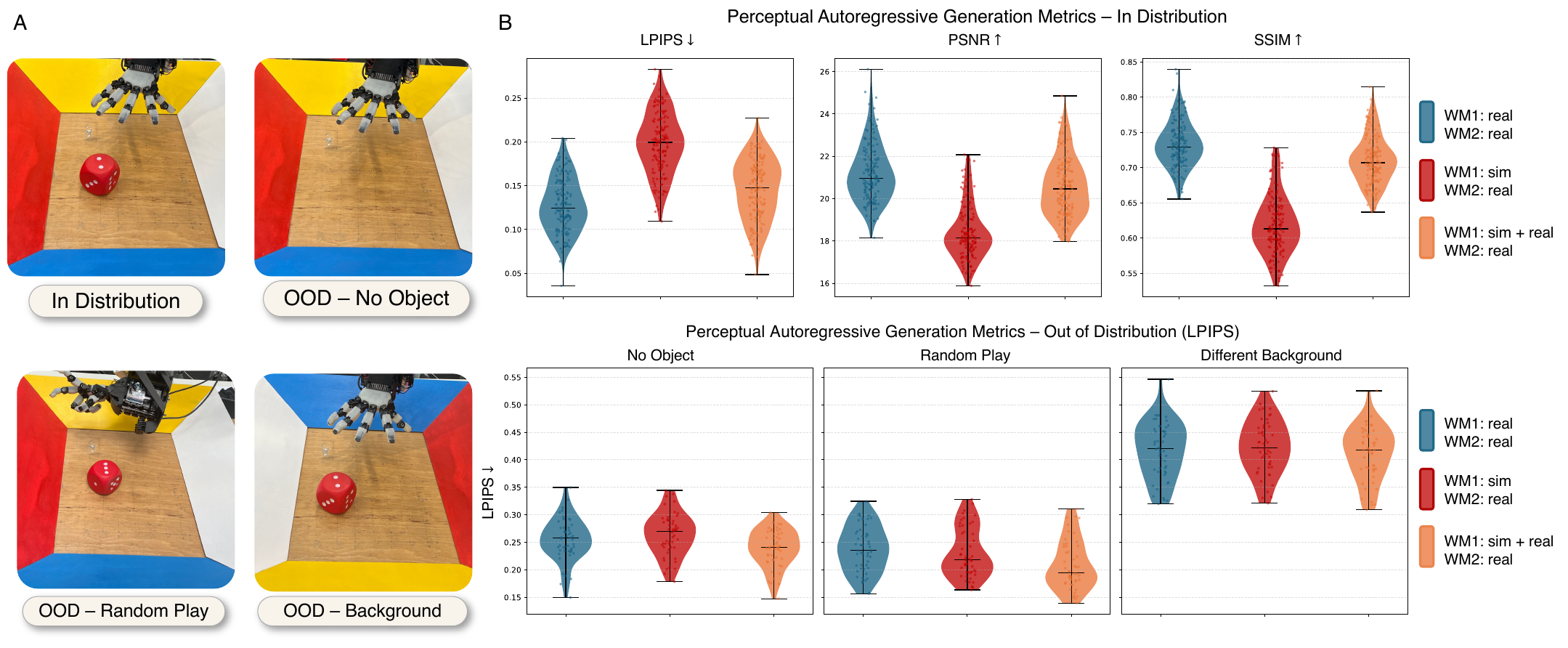
The real training data is concentrated around grasping and free-play manipulation and contains only limited isolated single-finger motion. Simulation midtraining alone lifts controllability from ≈0.68→0.85 (ID) and ≈0.51→0.73 (OOD); real fine-tuning then closes the remaining gap to 0.95 ID / 0.87 OOD, with the largest benefit on near-grasp OOD configurations.
Long-horizon rollouts
Autoregressive rollout, ours vs. monolithic
Autoregressive rollout on a pick-and-place sequence with the cup, comparing Mask2Real-WM against the monolithic baseline.
Mask2Real-WM (ours): sharp contacts, stable object identity
Monolithic baseline: blur and drift accumulate


Policy rollouts
Behavior unfolding inside the world model
These examples visualize how long-horizon behavior unfolds as ACT, Diffusion Policy, and Flow Matching are rolled out inside Mask2Real-WM. Each video shows both the third-person and wrist-camera views: the upper half is the starting image for each view, and the lower half is the policy rollout.
ACT · Sequence A
Diffusion Policy · Sequence A
Flow Matching · Sequence A
ACT · Sequence B
Diffusion Policy · Sequence B
Flow Matching · Sequence B
Generalization
Cup, banana, cylinder
Qualitative predictions on different manipulation targets.



Limitations
Where the system still falls short
All principal failure modes trace back to WM1. Without depth information, WM1 loses objects under hand occlusion. Over long horizons, the color-class mask carries no object-level identity, causing drift that text-prompt or object-ID conditioning could address.
Synthetic masks are perturbed only with a fixed Gaussian blur on rasterization edges — a coarse proxy for SAM 3's actual real-world error modes (boundary noise, occasional misclassification, temporal flicker); matching that error distribution more closely would likely narrow the sim-to-real gap further. WM1's diffusion backbone also denoises masks in pixel space; a JEPA-style architecture that predicts future states directly in a learned latent space, paired with a decoder trained to recover semantic masks from that latent, is an alternative we haven't explored.
WM2 is trained on real data from a single physical arena, so its rendering has not been evaluated in visually distinct scenes beyond the rotated-arena split. Its SVD-ControlNet backbone could also be replaced with a larger, more capable video foundation model such as Cosmos-Transfer, purpose-built for multimodal-conditioned world generation, at the cost of substantially more compute.
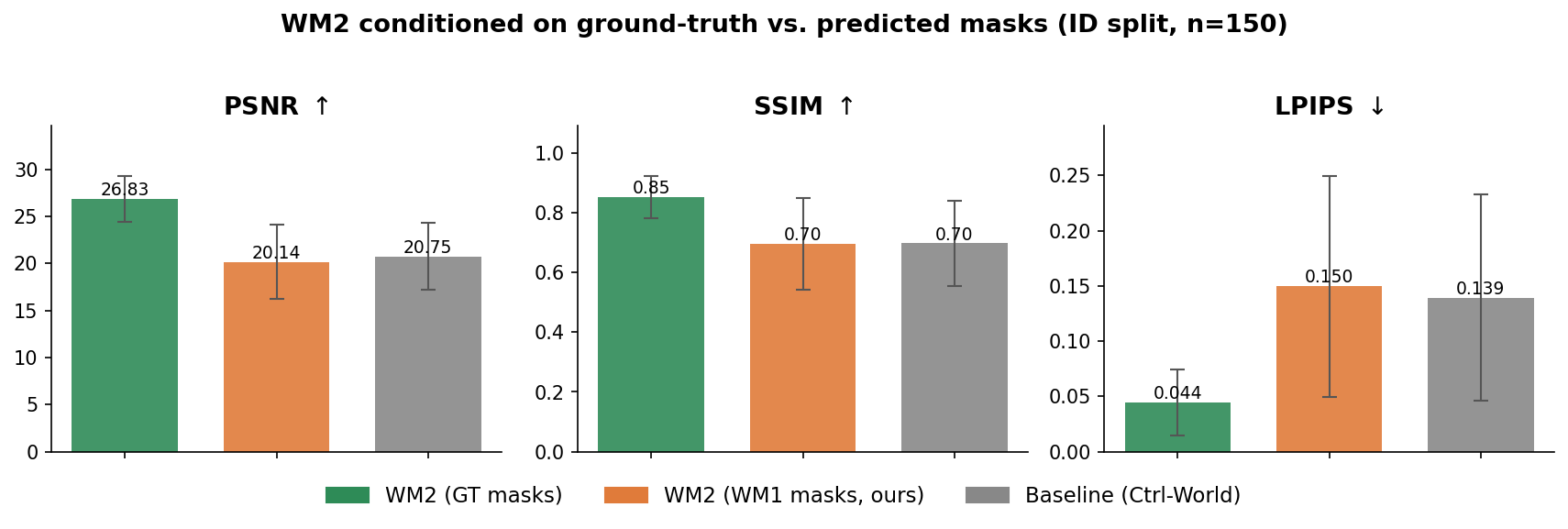
Because the baseline has no simulation exposure while WM1 is midtrained on over 50 h of synthetic data, our comparison can't separate gains from the mask factorization from gains from simply seeing more data. Finally, two sequential diffusion passes are expensive; distilling both stages into consistency models is a promising route to near-real-time inference.
BibTeX
Cite this work
@article{feingold2026mask2realwm,
  title   = {Mask2Real-WM: Segmentation Masks as a Sim-to-Real Bridge
             for Controllable Dexterous World Models},
  author  = {Feingold, Riccardo Orion and Liconti, Davide and
             Yang, Chenyu and Katzschmann, Robert K.},
  journal = {arXiv preprint arXiv:2607.04546},
  year    = {2026}
}