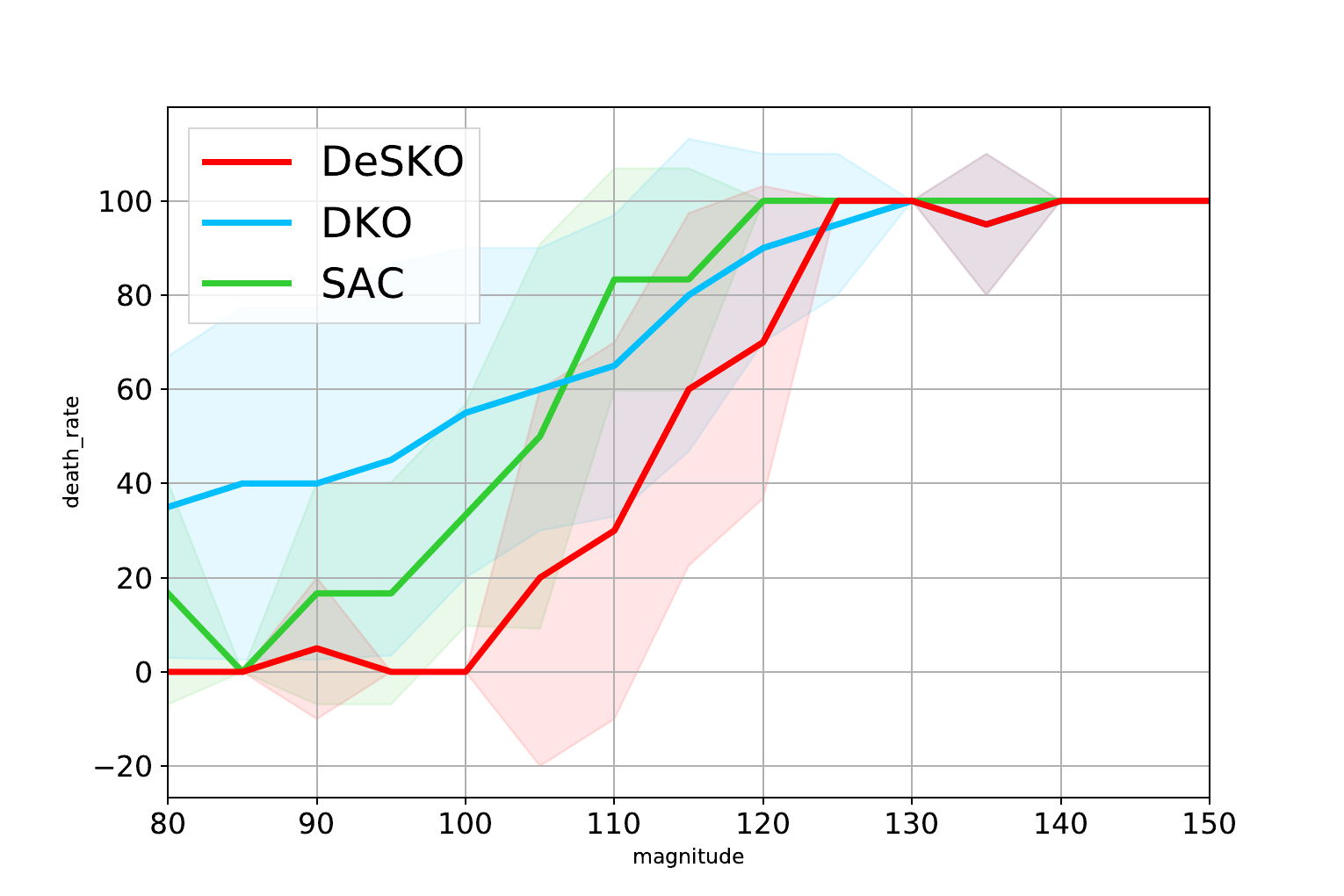
DeSKO achieved the best robustness in every disturbance test. In key CartPole settings, it resisted persistent 100 N disturbances without failure—even though the maximum control input was only 20 N.
100 trials at every disturbance magnitude.
The Koopman operator theory linearly describes nonlinear dynamical systems in a high-dimensional functional space and allows linear control methods to be applied to highly nonlinear systems. However, the Koopman operator does not account for uncertainty, which limits its performance in real-world applications.
We propose a deep stochastic Koopman operator (DeSKO) in a robust learning-control framework for nonlinear stochastic systems. DeSKO captures uncertainty by inferring a distribution of observables, which is then used to design a robust, stabilizing closed-loop controller. Across advanced control benchmarks—including a soft robotic arm, a legged robot, and a biological gene regulatory network—DeSKO is more robust and scalable than prior deep Koopman and reinforcement-learning methods. It also resists previously unseen external disturbances with magnitudes up to five times the maximum control input.
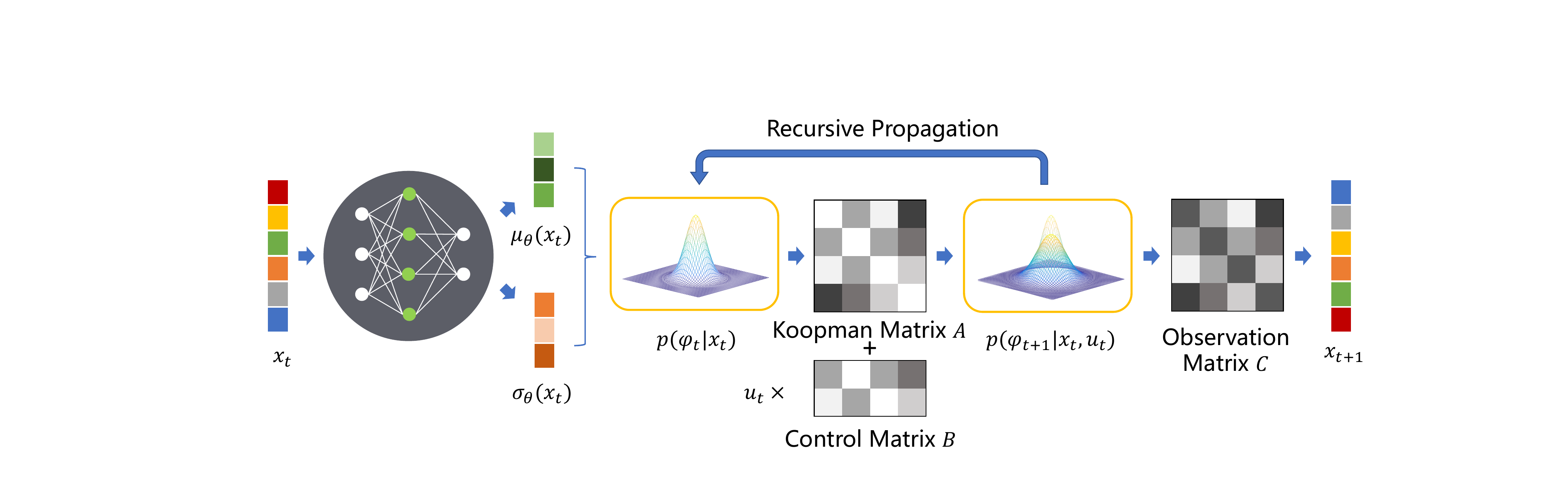
Two neural networks map the current state to the mean and diagonal variance of a distribution over observables.
Learned Koopman and control matrices recursively predict the observable distribution over the control horizon.
Robust MPC exploits the linear representation while providing stability guarantees under noise and residual error.
From a noisy state to a stability-assured control input.
The encoder maps the state to a distribution in the lifted observable space; reparameterized samples make the model trainable end to end.
The learned Koopman matrix \(A\) and control matrix \(B\) propagate each observable sample linearly; \(C\) maps it back to the original state.
A multi-step prediction objective trains the encoder, Koopman dynamics, and decoder jointly over horizon \(H\), reducing recursive rollout error.
MPC plans the nominal input \(c_t^*\) in the linear latent dynamics, while LQR feedback \(K\) corrects deviations caused by uncertainty.
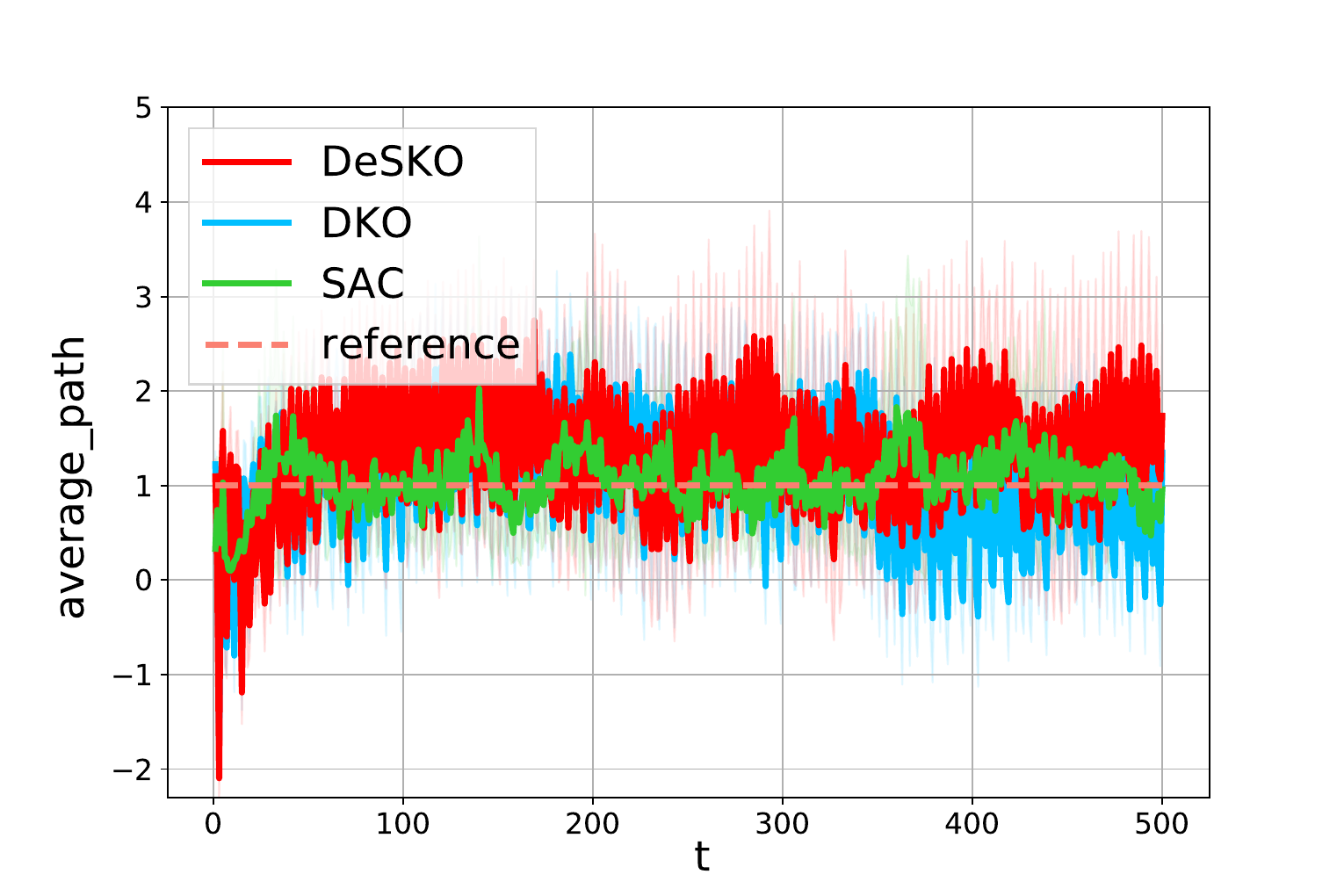
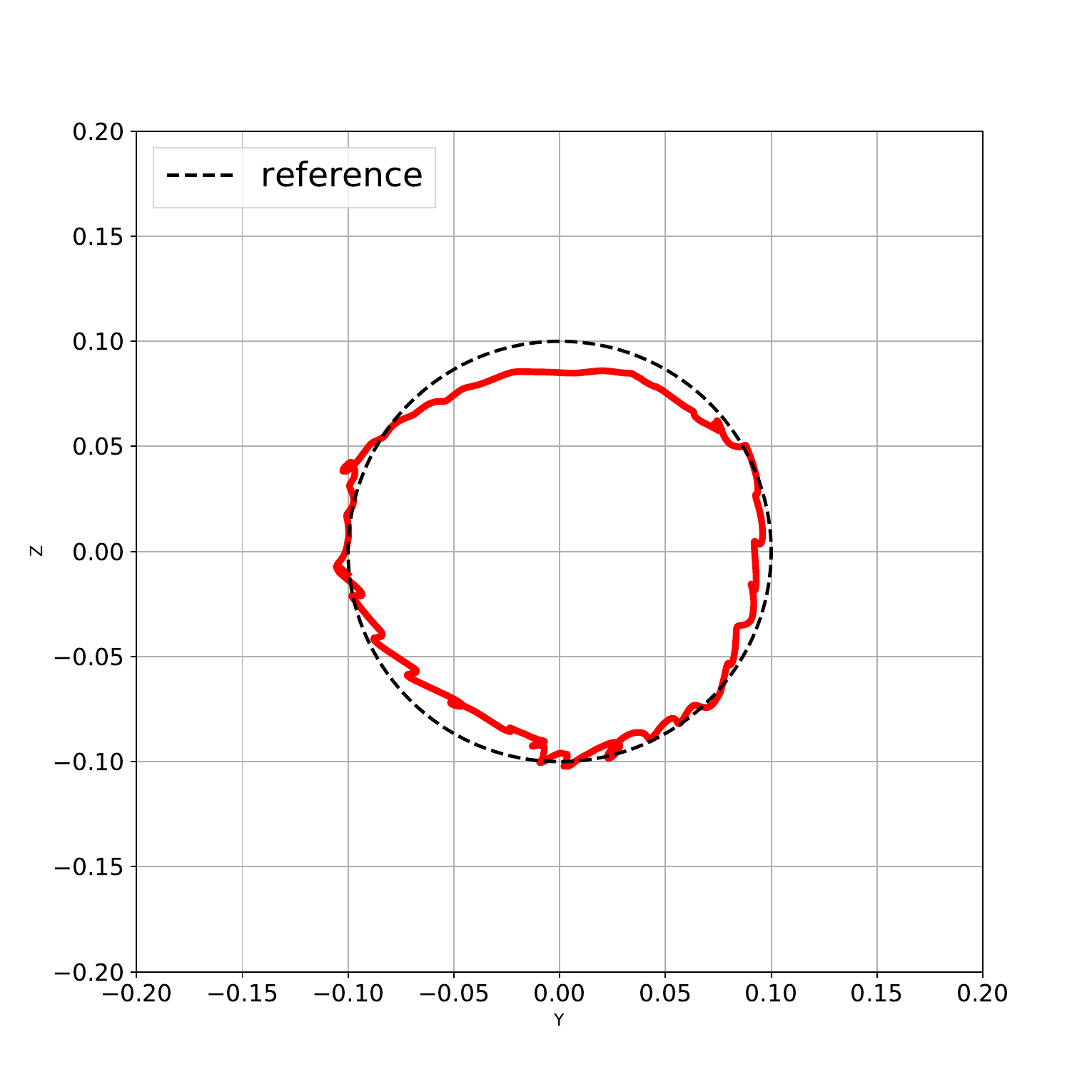
Evaluated on eight settings spanning CartPole, gene regulatory networks, HalfCheetah, and the SoPrA soft arm.
DeSKO achieved the best robustness in every disturbance test. In key CartPole settings, it resisted persistent 100 N disturbances without failure—even though the maximum control input was only 20 N.
100 trials at every disturbance magnitude.
Stochastic Koopman learning. DeSKO captures uncertainty directly in the lifted observable space while preserving linear propagation.
Efficient robust MPC. The controller uses distributional predictions without giving up the computational benefits of Koopman linearity.
Closed-loop stability. The analysis proves uniform ultimate boundedness under stochastic noise and Koopman approximation error.
@inproceedings{han2022desko,
  title     = {DeSKO: Stability-Assured Robust Control of Nonlinear Systems with a Deep Stochastic Koopman Operator},
  author    = {Han, Minghao and Euler-Rolle, Jacob and Katzschmann, Robert K.},
  booktitle = {International Conference on Learning Representations},
  year      = {2022}
}