Robust Learning-Based Control for Uncertain Nonlinear Systems With Validation on a Soft Robot

Soft Robotics Lab, ETH Zürich  ·  Harbin Institute of Technology
IEEE Transactions on Neural Networks and Learning Systems, 2025
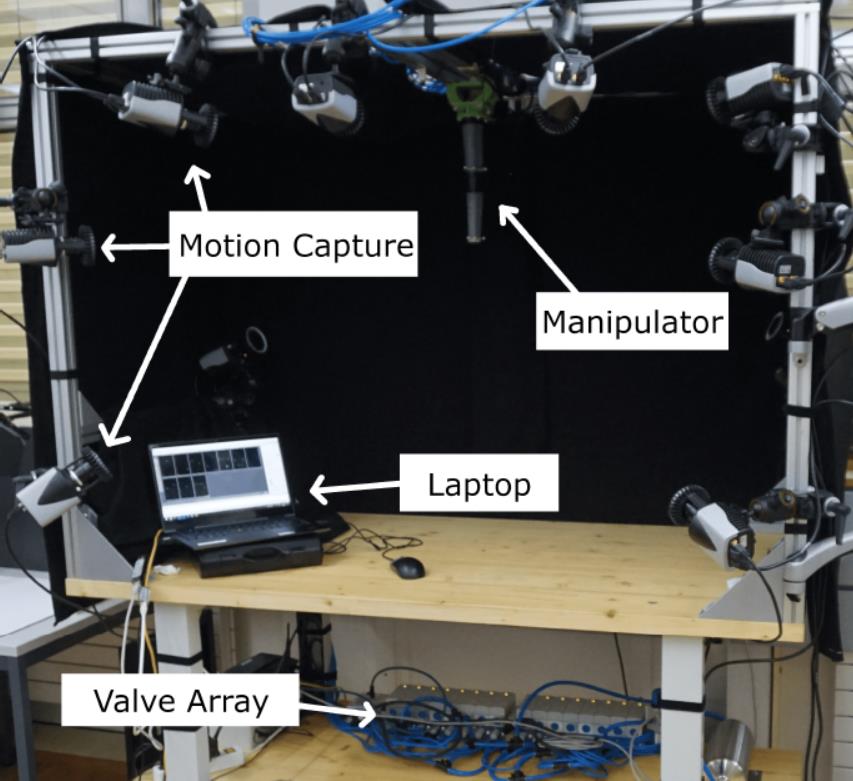
The real SoPrA soft robotic arm, motion-capture cameras, pneumatic valve array, and control computer.

A DeSKO model learned from 40 minutes of robot data supports 100 Hz robust control, accurate trajectory tracking, and pick-and-place with unseen payloads.

Abstract

We present a robust learning-based control framework for uncertain nonlinear systems and validate it extensively on a physical SoPrA soft robotic arm. The deep stochastic Koopman operator (DeSKO) learns a distribution of observables, enabling efficient robust MPC with a closed-loop stability guarantee.

On the real robot, DeSKO outperforms deep Koopman, classical Koopman, and model-based controllers in dynamic tracking and uncertainty tests. An augmented integral controller compensates for unseen payloads at run time, enabling object pick-and-place without recollecting data or retraining the model.

Learning and Control

1

Learn on the robot

200,000 state-action pairs are collected in 40 minutes from randomized pneumatic inputs to the two-segment SoPrA arm.

2

Control at 100 Hz

DeSKO predicts 30 steps ahead; robust MPC commands six chamber pressures while feedback rejects model and measurement errors.

3

Adapt without retraining

Integral feedback accumulates tracking error and compensates for the gripper and objects absent from the training data.

Robust MPC With Integral Action

The nominal DeSKO controller is augmented to reject run-time parametric uncertainty.

1Nominal model
\[p_\theta(\psi_t\mid x_t)=\mathcal{N}\!\left(\mu_\theta(x_t),\sigma_\theta(x_t)\right),\qquad \hat\mu_{t+1}=A\hat\mu_t+Bc_t\]

DeSKO encodes state uncertainty in the observable space, while MPC plans the nominal input \(c_t^*\) using linear lifted dynamics.

2Robust feedback
\[u_t=c_t^*+K\!\left(\mu_\theta(x_t)-\hat\mu_t\right)\]

The LQR gain \(K\) stabilizes the mismatch between the measured robot state encoded by DeSKO and the nominal MPC trajectory.

3Integral augmentation
\[\begin{bmatrix}\bar{x}_{t+1}\\ \mu_{t+1}\end{bmatrix}= \underbrace{\begin{bmatrix}I&-C\\0&A\end{bmatrix}}_{\bar A} \begin{bmatrix}\bar{x}_t\\\mu_t\end{bmatrix}+ \underbrace{\begin{bmatrix}0\\B\end{bmatrix}}_{\bar B}u_t+ \begin{bmatrix}I\\0\end{bmatrix}r_t\]

The cumulative output error \(\bar{x}_t\) is added to the lifted state, exposing constant payload-induced bias to the feedback controller.

4Integral controller
\[u_t=c_t^*+\begin{bmatrix}\bar K&K\end{bmatrix} \begin{bmatrix}\bar{x}_t\\\mu_\theta(x_t)-\hat\mu_t\end{bmatrix}\]

The augmented LQR gains \(\bar K\) and \(K\) act on accumulated output error and latent tracking error. MPC itself remains unchanged.

Stability guarantee. With bounded noise and bounded Koopman approximation residuals, the closed loop is uniformly ultimately bounded by \[\frac{\beta\sigma(Lb+\gamma)}{1-\beta}+\eta.\]

Real-World Evaluation

A 12-state, six-input SoPrA arm is controlled at 100 Hz with a 30-step horizon and chamber pressures constrained to 0-600 mbar.

Dynamic trajectory tracking

DeSKO tracks the S, R, and L references with average errors of 1.28, 1.30, and 1.33 cm. It is the best method on every letter, outperforming DKO, classical KO, and a model-based controller with full model knowledge.

Up to 4× lower error than DKO across the three tasks.
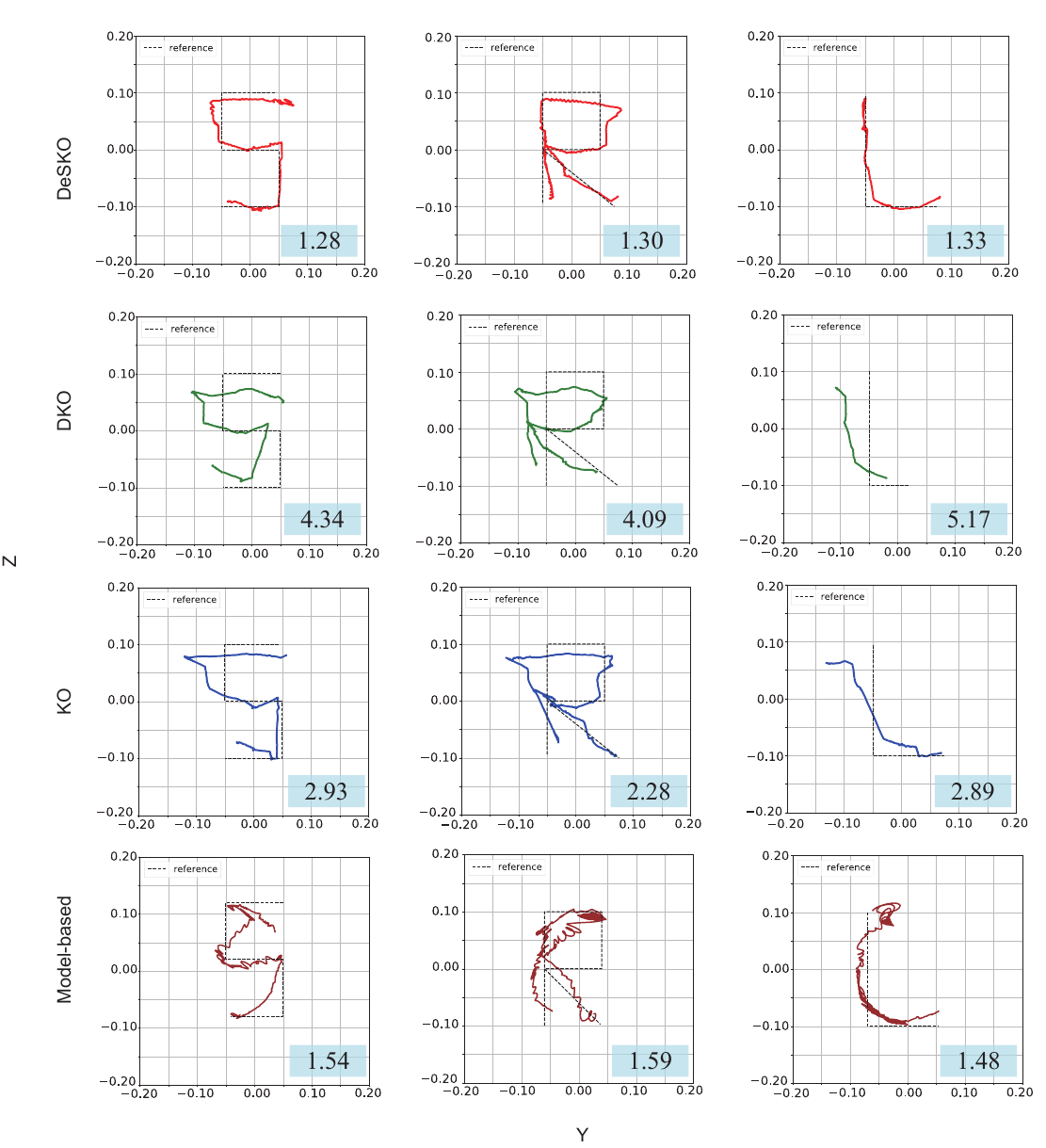
Real SoPrA tracking results for S, R, and L trajectories using DeSKO, DKO, classical Koopman control, and model-based control.
Letter tracking on the physical arm. Values are mean endpoint errors in centimeters.

Robust to noise and payloads

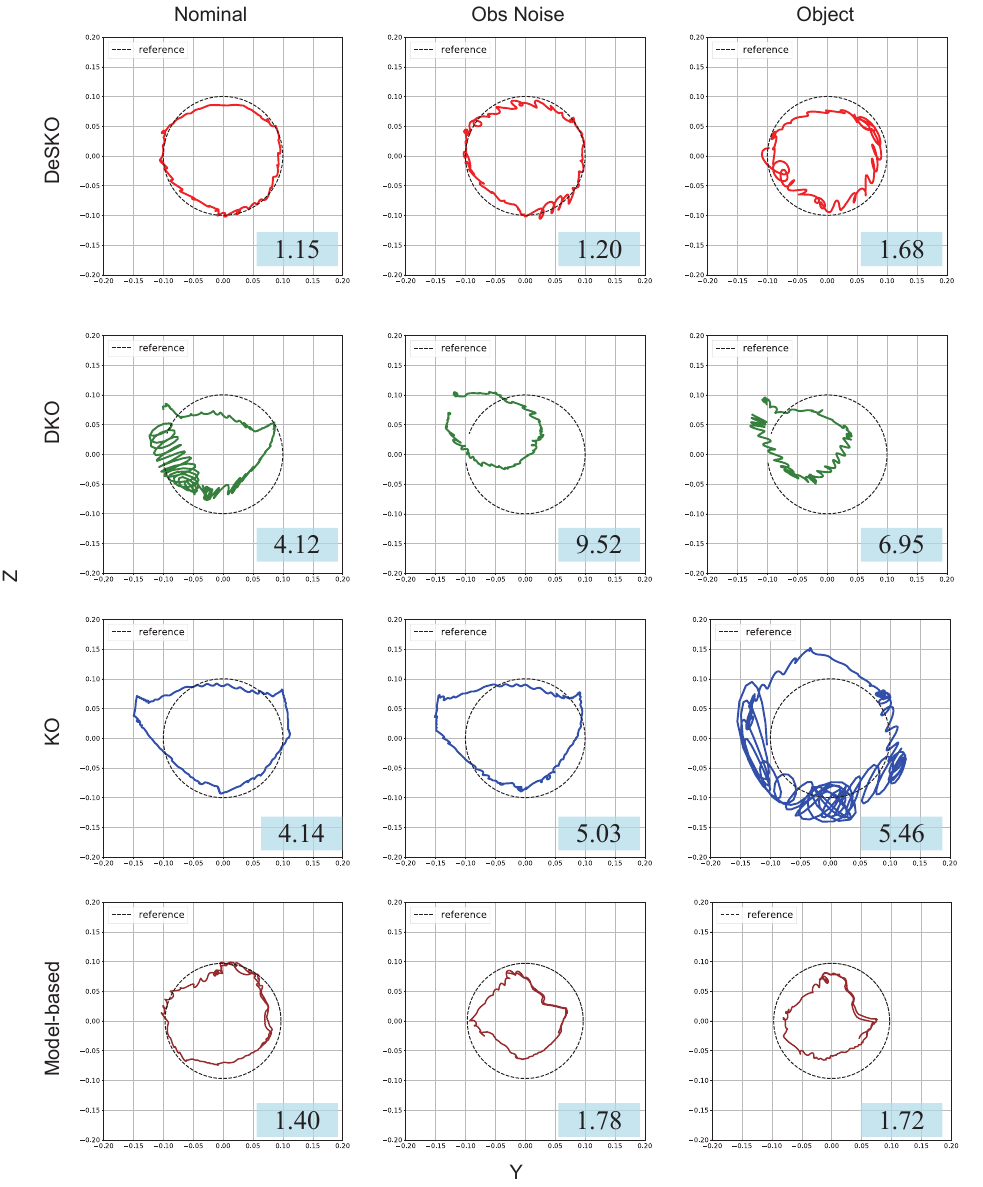
For circular tracking, DeSKO records 1.15 cm nominal error, 1.20 cm with uniform observation noise, and 1.68 cm while carrying an unseen tape payload. These are the lowest errors in all three conditions.

Observation noise increases DeSKO error by only 4.4%, versus 131.1% for DKO.

Circular trajectory tracking under nominal conditions, observation noise, and an unseen tape payload for four controllers.
Robustness comparison on the physical arm. Values are mean endpoint errors in centimeters.
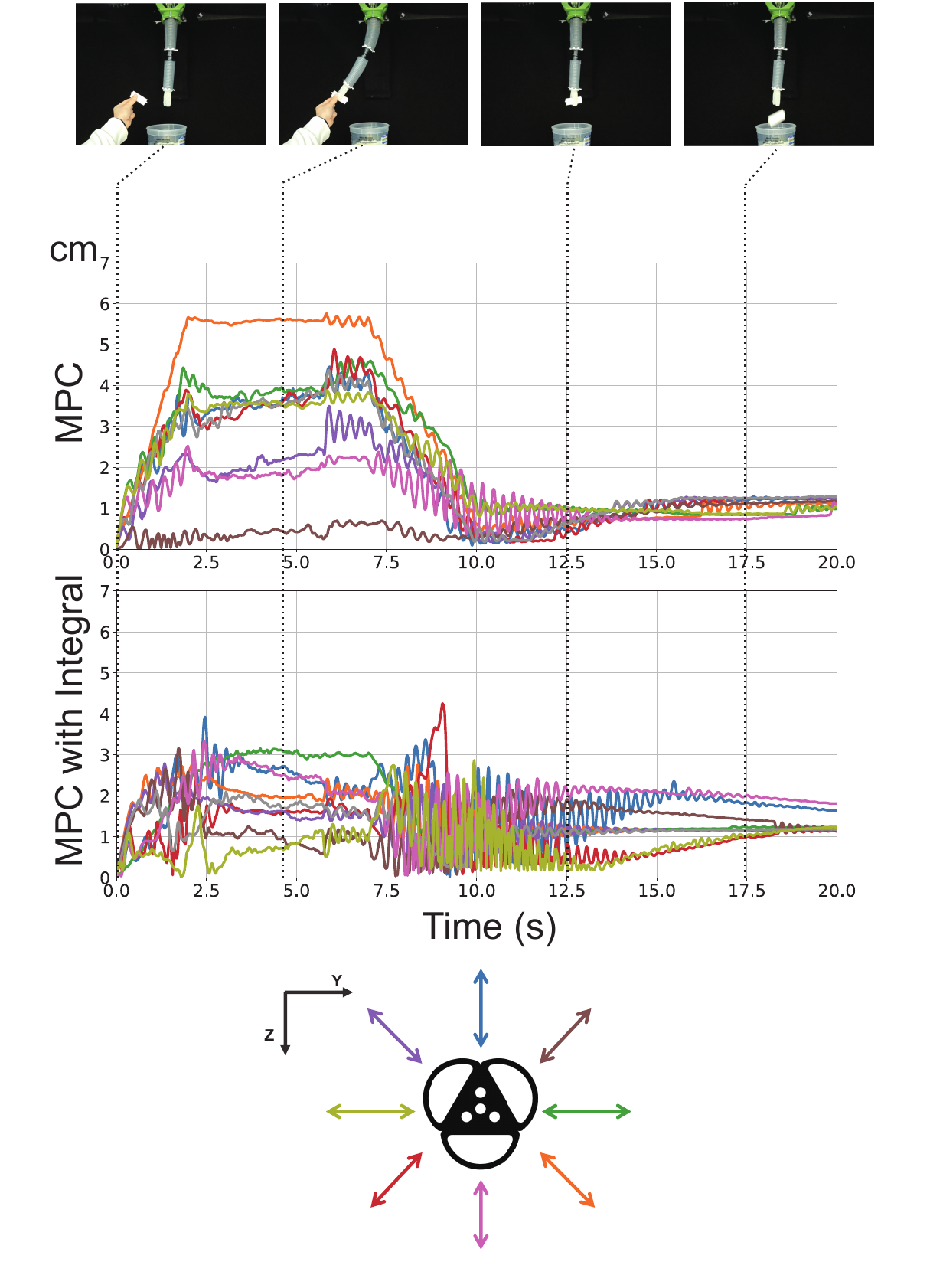
Pick-and-place tracking errors from nine cube positions with MPC and MPC plus integral control, including robot keyframes.
Cube picking. Integral action raises success from 22.2% to 66.7% across nine starting positions.
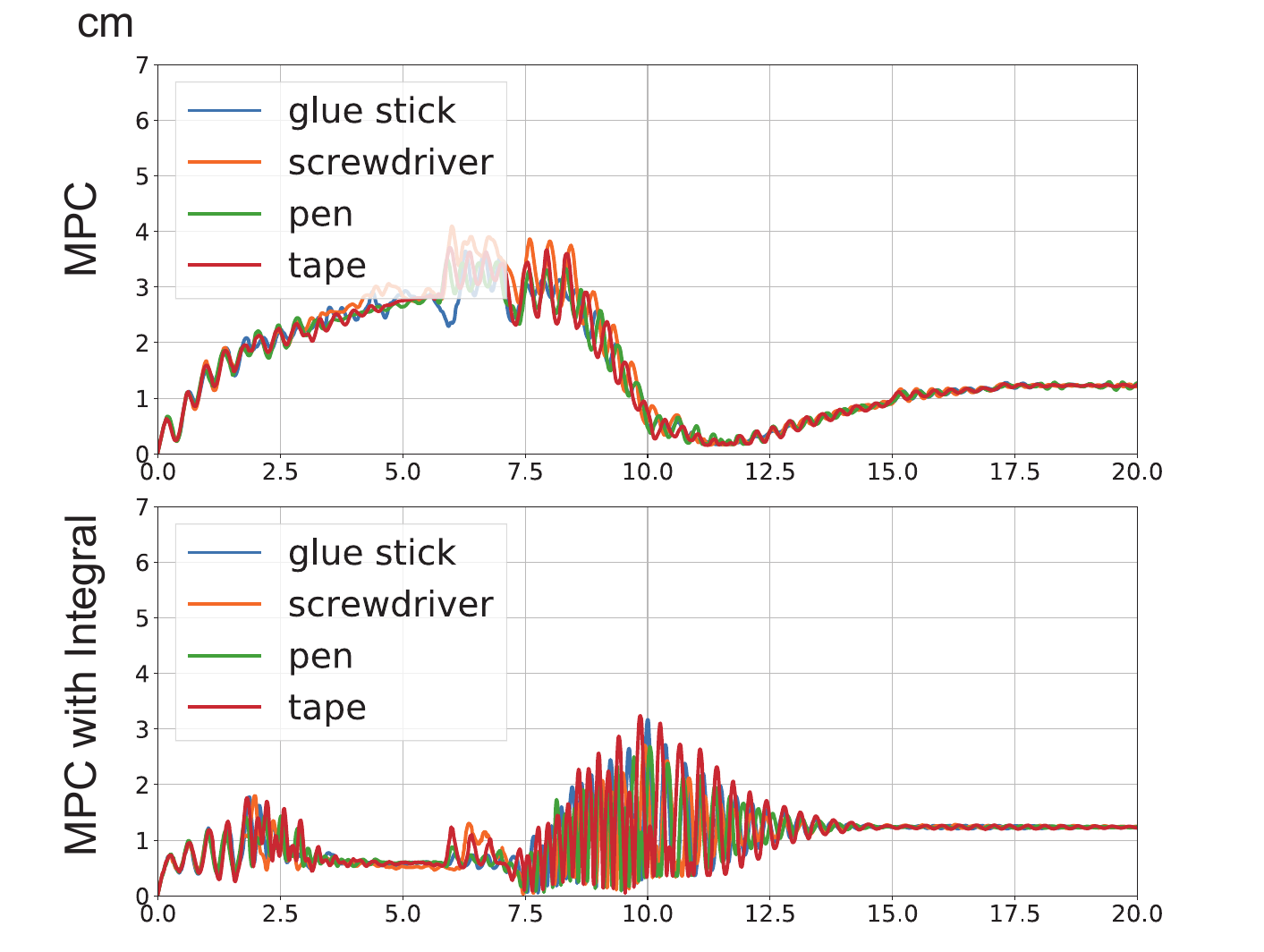
Pick-and-place tracking errors for a glue stick, screwdriver, pen, and tape with and without integral control.
Unseen common objects. Integral action raises grasping success from 0% to 100% without retraining.

What the Robot Experiments Show

Accurate dynamic control. The learned Koopman model supports real-time MPC and consistently gives the lowest tracking error across letter-shaped trajectories.

Robustness beyond the dataset. DeSKO tolerates measurement noise and a gripper-plus-object payload that was entirely absent during data collection.

Integral action enables manipulation. Augmenting feedback with cumulative tracking error removes payload-induced bias and turns failed common-object grasps into 100% success.

BibTeX

@article{han2025robust,
  title   = {Robust Learning-Based Control for Uncertain Nonlinear Systems With Validation on a Soft Robot},
  author  = {Han, Minghao and Wong, Ki Wan and Euler-Rolle, Jacob and Zhang, Lixian and Katzschmann, Robert K.},
  journal = {IEEE Transactions on Neural Networks and Learning Systems},
  volume  = {36},
  number  = {1},
  pages   = {510--524},
  year    = {2025},
  doi     = {10.1109/TNNLS.2023.3328643}
}